In this article:
- Does my dog follow me into the bathroom because they love me?
- Does my dog follow me into the bathroom because of separation anxiety?
- Does my dog follow me into the bathroom to protect me?
- Does my dog follow me into the bathroom for the smell?
- Should I let my dog follow me into the bathroom?
- How do I get my dog to stop following me into the bathroom?
Mars, a 10-year-old Belgian Tervuren-Groenendael mix, had no trouble learning to jump, stand on his hind legs, and eat on cue. But one concept long eluded him: privacy. For years, he wanted to go everywhere his favorite person went—including the bathroom.
Mars’ person—Ian Dunbar, PhD, BVetMed, Member of the Royal College of Veterinary Surgeons—keeps his dog within petting distance almost all the time, but drew the line at the loo. “I think it’s a wonderful thing when the dog follows us,” Dr. Dunbar said, “but I don’t want a nose sniffing my naked butt.” (Straight to the point.) Using positive reinforcement, he trained Mars to wait outside while he used the lav. We’ll share tips on that later.
Regardless of whether you welcome your dog into the water closet, you may wonder why they want to be in there with you. In pursuit of the answer, we asked experts why so many dogs seem determined to be their people’s bathroom buddies.

Does my dog follow me into the bathroom because they love me?
“Ask 10 trainers and you’ll get 10 completely different reasons,” Dr. Dunbar said when asked why dogs follow their people into the bathroom. “I would say the dog just wants to be with you.”
After all, he said, “There’s you in there!” And when you shut the door behind you, your dog doesn’t know what you’re up to. “It’s a time when some people will shut the door and disappear for an hour.” If your dog is used to staying by your side, it’s only natural that they would take an interest in everything you do—even if you’re shaving or sitting on the toilet.
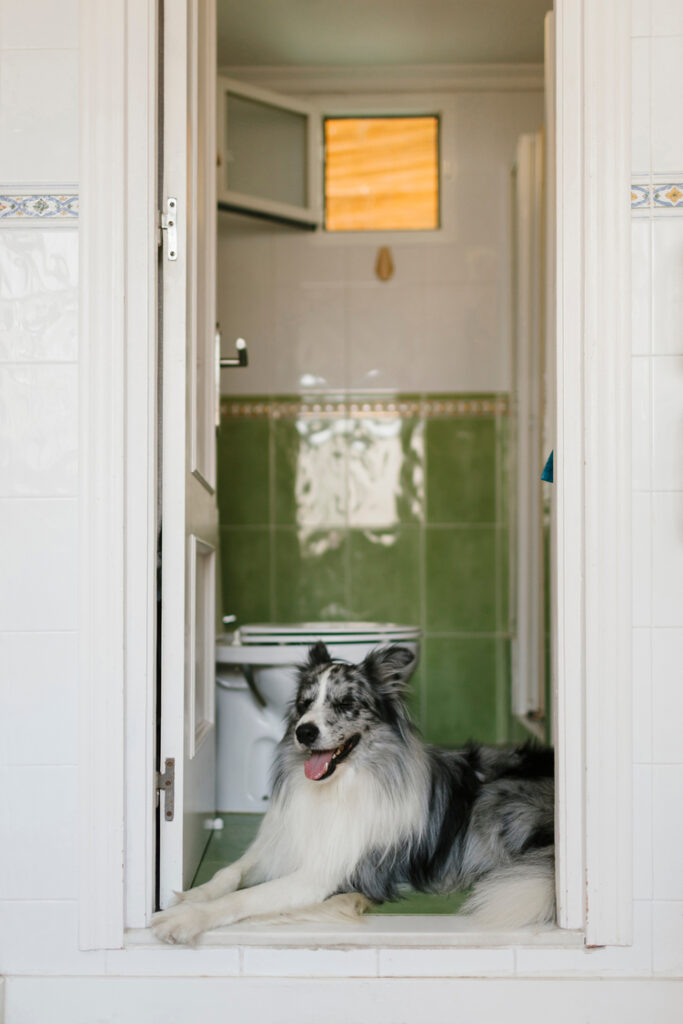
Your dog might follow you anywhere—so why not the bathroom? Dogs don’t know that it’s more sensitive than any other place.
“The dog views the bathroom as a human crate,” Dr. Dunbar said. He speculated that a dog’s thinking might look something like this: “‘[Humans] go in [the bathroom], and they’re confined for a lot of time, and I would much rather they be with me.’ It’s as simple as that.”
Does my dog follow me into the bathroom because of separation anxiety?
While “your dog loves you and wants to be with you” is the simplest explanation for their attempts to get past the bathroom bouncer, the internet is littered with other theories. What about the idea that it means your dog has separation anxiety? The answer is that this is possible, but not particularly likely.
“Why particularly the bathroom if they have separation anxiety?” said Stanley Coren, PhD, DSc, a professor emeritus of psychology at the University of British Columbia. A “Velcro dog” who follows you everywhere, including the bathroom, may be attached to you, but doesn’t necessarily suffer from separation anxiety; a dog who can’t stand to be apart from you for 30 seconds may need some serious attention. If your dog engages in other behaviors that trouble you, such as destruction and excessive vocalizing when you’re apart, talk to your vet.
A 2014 paper on canine separation anxiety published in the journal Veterinary Medicine: Research and Reports identifies the most common behaviors marking separation anxiety as “destruction of property and excessive vocalization when left alone.” Other behaviors associated with separation anxiety listed in the paper include:
- Inappropriate peeing and pooping (such as indoors, even if they’re house-trained)
- Overgrooming to the point of harm
- Repetitive motor activities like pacing
- Attempts to escape
- Trembling
- Salivation
- Depression
“Separation anxiety is used as a catchall for a dog who misbehaves when you’re not at home,” Dr. Dunbar said. While you’re still home when you go into the bathroom, for a dog with separation anxiety you might as well be on another planet, and they will behave differently when separated. If your dog barks or whines excessively, or behaves in another extreme or distressing way listed above, whenever they must be apart from you, those could be signs of separation anxiety that warrant a vet visit.
Does my dog follow me into the bathroom to protect me?
Another popular internet explanation for dogs’ desire to follow their people into the bathroom is that it’s a way of returning the favor for your protection while walking them—standing guard while you’re vulnerable. Dr. Coren called this “absolute nonsense.”
“One of the reasons that scolding dogs if they pee on the carpet doesn’t work is because it’s such a casual behavior that the dogs have forgotten it 20 seconds after they’ve finished,” he said. “It’s not a major thing in their life, and they certainly don’t care if we watch when they’re out on a walk.”
It’s also worth noting that when you take a dog to the bathroom, they may be out in the open with other creatures out and about, while your bathroom is an enclosed, private space that is presumably predator-free.
Does my dog follow me into the bathroom for the smell?
Dogs have a famously sharp sense of smell, which serves the purpose of learning information about their surroundings, other creatures, and where to find food. Dr. Coren posited that this ability extends to the bathroom, which is full of all kinds of smells relaying information about a dog’s humans.
Dogs sniff each other’s butts when they meet to learn about each other. These areas emit chemicals called pheromones, which are natural compounds that carry crucial biological information about a creature. For example, pheromones can reveal whether a female dog is in heat. But dogs typically can’t access that same information from humans.
“Normally those areas are covered on human beings, and they tend to obscure the scent—except when we go to the bathroom,” Dr. Coren said. “Suddenly, there’s a big burst of these pheromones in the air. That’s the reason why the dog will crowd close to us when we’re sitting on the toilet.”
Dr. Dunbar understood this line of thinking, but was not convinced by it. He said that while dogs do learn about each other through pheromones, his own scent research found that dogs were far more interested in the smell of other dogs’ urine than humans’. At one point, he investigated how dogs responded to the scent of human urine, but they were so indifferent to it that he never published the results.
Should I let my dog follow me into the bathroom?
Whether you ought to allow your dog in the bathroom with you is up to you. It’s one of many choices that comes down to your preferences. Dr. Dunbar mentioned, for instance, that some people don’t like their dog seeing them undressed.
But even if you don’t mind some canine company in the can, keep your dog safe: Make sure they don’t drink out of the toilet; secure the garbage in case they try to dig through your trash; and keep all medications and toxic substances out of reach.
If you’d prefer your dog leave you alone while you’re in the bathroom, then you both have a little training to do.
How do I get my dog to stop following me into the bathroom?
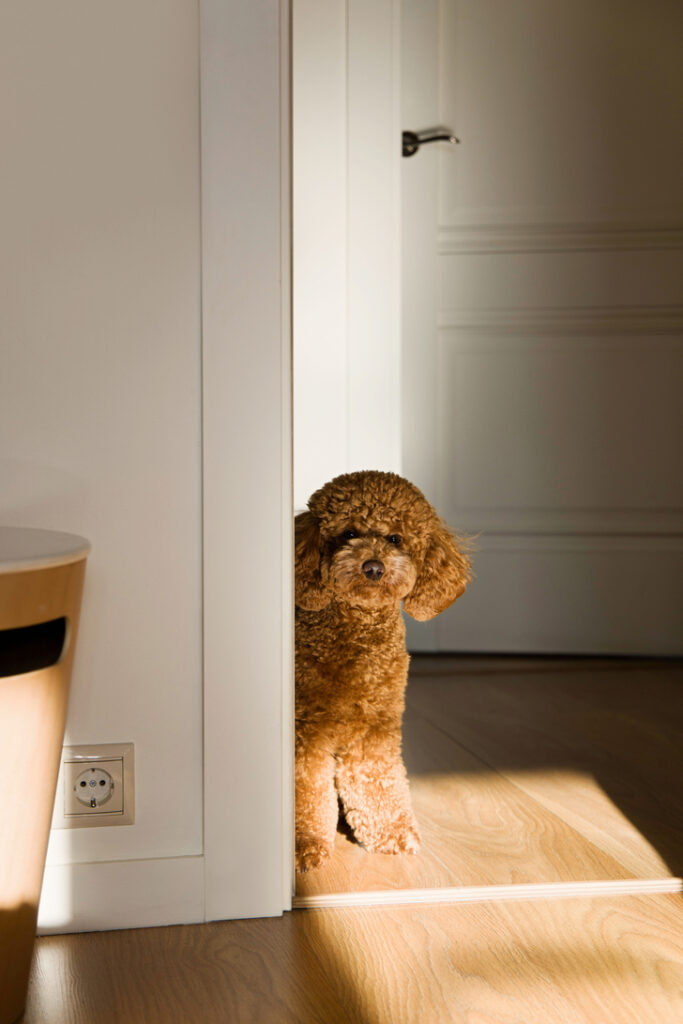
If you want to be alone in the restroom, you can train your dog to give you some space in there—and you can do so kindly. While you can shut the door before your dog follows you in, training them to wait outside occupies them so they’re not left hanging. The two cues Dr. Dunbar said he uses with Mars for this purpose are “outside” and “down.”
To teach your dog “outside,” Dr. Dunbar recommended stepping into the bathroom when you don’t have to go, as practice. Reward your dog as they move toward the door, encouraging them to stay on the other side of the doorway while you’re still inside. This cue can transfer to other places—like the kitchen, if your dog likes to counter surf.
You can also teach the cue “place.” Put down a mat so there’s a designated spot for them to go “down.” If they seem eager to stay by your side, you can put the mat right outside the bathroom. Make this spot joyful for them by offering a toy, chew, or treat-filled Kong. These tools do double duty, keeping your dog occupied and creating a positive association with your dog’s “place” or “outside-down” spot.
No matter how you handle the situation, never punish your dog for following you into the bathroom. They don’t have any reason to think you have a special need for privacy in there, and don’t understand human taboos. All they want is to be near you.
Dr. Dunbar appreciated this loving impulse in Mars, which is why he compromised by putting his “outside-down” spot close to where the action is. “It’s a private moment,” Dr. Dunbar said, “but [he] can enjoy it with me—outside the bathroom door.”
The post Why Does My Dog Follow Me Into the Bathroom? appeared first on The Farmer’s Dog - Digest.
Comments
Post a Comment