In this article:
- Why might I want to hand-feed my dog?
- Can hand-feeding positively reinforce good dog behavior?
- Can hand-feeding help teach a dog self-control?
- Can hand-feeding help teach a dog “soft mouth”?
- Can hand-feeding help teach a dog to eat more slowly?
- How much food should I hand-feed my dog?
- Should I hand-feed my dog who guards resources?
- Should I hand-feed my puppy?
- Should I hand-feed my dog to bond with them?
- When shouldn’t I hand-feed my dog?
- Should I hand-feed my new or foster dog?
- Should I hand-feed my dog all the time?
The very idea of dog food sometimes seems inexorably tied to the bowl, that reliable concave serving vessel. But, whatever its merits, a bowl is not the only vehicle for feeding your dog—in fact, almost everyone who’s ever trained a dog has, at one time or another, fed their best friend by hand. And, if your dog feels safe and comfortable with it, some amount of hand-feeding can be a great way to enhance your bond.
“I only offer treats by hand when the dog is looking super relaxed,” said Ilya Fischhoff, PhD, a dog trainer and behavior consultant at Compassionate Dude Dog Training. And, even then, hand-feeding isn’t so much a way to build a new bond as it is the proof and reinforcement of an existing bond.
Hand-feeding can be a useful tool as you aim to get closer to your dog and help them build new skills, but it’s not for every dog—and, in most cases, shouldn’t be the primary way you feed a dog. Here’s what to know as you decide whether, and how often, to hand it to them.
Why might I want to hand-feed my dog?
Fast reinforcement
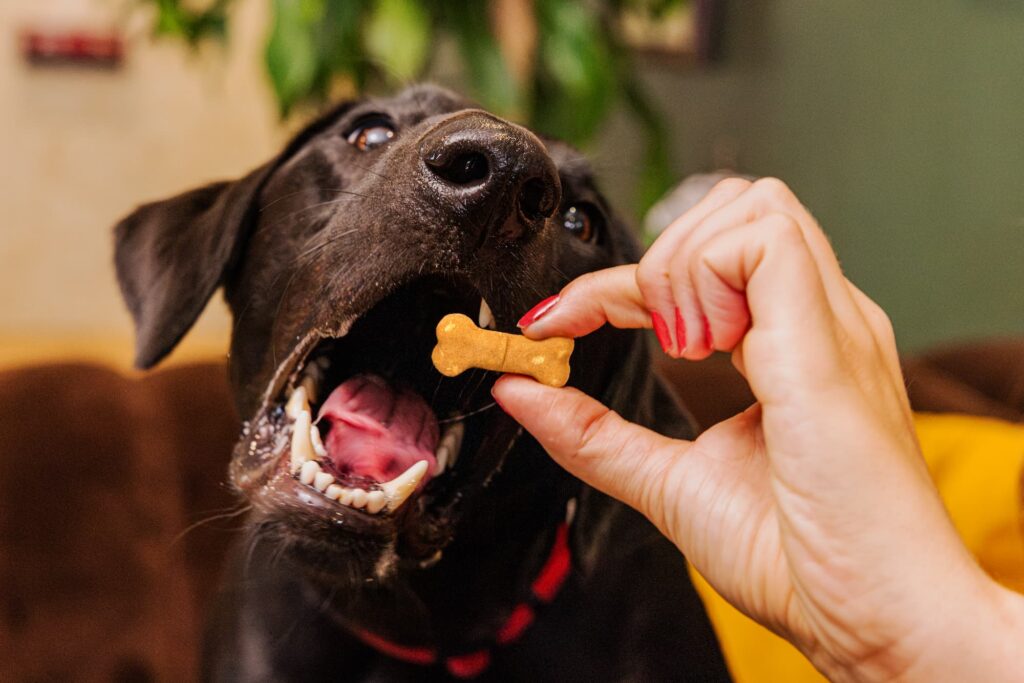
As noted above, most dog people already use hand-feeding as part of training. When you hand your dog a treat, the immediate positive reinforcement helps your dog learn or practice a skill. Hand-feeding a treat is often the quickest way to help your dog associate a new behavior with a cue and reward, incentivizing them to repeat it.
Teaching self-control
Hand-feeding can also be integral to training skills like the impulse-control behavior “leave it.” Training your dog to “leave it” looks like this:
- Hold a treat in your closed fist.
- Let your dog sniff and lick your hand as they try to get the treat.
- As soon as they lose interest and turn away, lavish them with praise and offer them the treat from your open hand while saying “take it” or “okay.”
Learn more about the full training process for “leave it” here.
Teaching “soft mouth”
Hand-feeding also comes in handy for teaching the skill “soft mouth.” “Soft mouth” is the ability to control bite strength, which many dogs learn as puppies by playing with other dogs, though people can also teach it. Dr. Fischhoff recommended the “leave it” method for training “soft mouth,” because “dogs tend to have a softer mouth when the food’s on the palm of your hand,” he said. Try using the same method you’d generally employ to train “leave it,” but only give your dog the treat when they approach it without biting. If they try to bite, start again and only let them have it when they can be gentle.
Teaching slow eating
If your dog is a fast eater, then hand-feeding can also help them slow down because you’re limiting the amount of food they can eat at once. You can also dole out small handfuls or tiny bits of food onto the floor for your dog to eat piecemeal. (A slow feeder, frozen, food-filled Kong, or puzzle mat helps, too.)
How much food should I hand-feed my dog?
If you do use food to train your dog, remember that treats should make up no more than 10% of their total daily calorie intake. If you use their regular food, then you can structure training around mealtimes, using their typical portion—just make sure they eat from the bowl sometimes to keep them in the habit. (More on that later.)
Should I hand-feed my dog who guards resources?
Some trainers say that hand-feeding can help mitigate resource-guarding behavior, particularly around food. But whether this is the best method for them depends on their individual behaviors. If you do decide to try hand-feeding a dog who guards resources, do so only under the guidance of a qualified, trusted trainer or veterinary behaviorist who can understand the subtleties of your dog’s actions. Never use hand-feeding as a way to force your dog to only accept food from you. If your dog isn’t comfortable taking food from your hand, feed them another way.
When someone gets too close to a resource-guarding dog at mealtime, the dog might:
- Eat too quickly
- Stop eating
- Adopt a rigid body posture
- Growl
- Lick their lips
- Bare their teeth
- Snap at or bite the intruder
Never hand-feed a dog who may bite you, whether or not they guard their food. Likewise, don’t hand-feed them if they appear fearful or stressed when taking food from your hand. One potential anxiety in dogs who food-guard, Dr. Fischhoff said, is that their food will be taken away. Hand-feeding may stoke anxiety around food, leading them to believe you’ll rescind their food since it’s in your hand. He cited a method from dog trainer Jean Donaldson to demonstrate the food is theirs: Drop some in their bowl and immediately walk away.
Maddie Messina, a certified dog trainer and founder of Paws for Thought Dog Training, recommended letting a resource-guarding dog eat alone behind a gate, which prevents them from engaging in resource-guarding behaviors. Over time, through counterconditioning, the dog can learn to associate stimuli they once perceived as threats—like someone approaching them during mealtime—with good things.
Hand-feeding can have a place in training a dog not to guard resources—helping them to create a positive association between you and their food—but only when they feel safe (and it’s safe for you). It’s best to explore this with a professional positive-reinforcement trainer or veterinary behaviorist who can advise you on how to walk this fine line with your dog.
Should I hand-feed my puppy?
If you have a puppy, you may want to incorporate hand-feeding into their routine—but don’t exclusively hand-feed them. Until they’re 12 or 14 weeks old, puppies experience a sensitive period “when the brain is most plastic,” Dr. Fischhoff said, during which they’re particularly open to novelty. This is the prime moment to introduce them to any animals, people, places, or objects they will encounter throughout their lives. While you want to acclimate them to eating from a bowl, Dr. Fischhoff underscored the importance of providing food in various ways; hand-feeding can teach your dog that when your hand gets close to them, good things (like food) appear.
Should I hand-feed my dog to bond with them?
As for the question of whether hand-feeding strengthens your bond with your best friend, “this depends on the dog and person, and may change from moment to moment,” Dr. Fischhoff said. If your dog will readily eat from your hand and this brings you joy, then that can create a positive feedback loop where you feel connected to your dog, and your dog picks up on and reflects those good vibes.
TLDR: If your dog enjoys eating from your hand, then feeding them from your hand can strengthen your bond. Whether it’s hand-feeding or any other good thing, associating yourself with positive experiences is a surefire way to get closer to your dog.
When shouldn’t I hand-feed my dog?
Sometimes it’s best to refrain from hand-feeding your dog, either from the palm of your hand or by dispensing food onto the floor. For example, never hand-feed a dog who bites or nips, or who appears fearful of taking food by hand.
When they bite
If your dog bites or snaps, it’s not safe for you to hand-feed them.
“Hand-feeding is especially not a good idea if the dog is suspected to have fear towards or potentially a history of aggression towards that individual or type of person, like a stranger or child,” said Katherine Pankratz, DVM, Diplomate of the American College of Veterinary Behaviorists, a veterinary behaviorist at the Animal Behavior Clinic in Portland, Oregon.
Also exercise caution when you want to offer a treat to someone else’s dog. If you see a dog in public, always ask their person for permission before feeding them a treat by hand (and don’t do it until after you’ve heard a clear “yes”).
When you’re still getting to know a new or foster dog
If you’ve just brought home a new pet or foster dog, wait until they’re totally at ease before trying to hand-feed them. Get to know their body language, especially around food, to make sure they’re not fearful.
Whenever you’re helping a dog through fear, it’s important to give them choices and make sure they stay under threshold and able to accept food and treats happily.
“I do not recommend using hand-feeding to establish a relationship with a newly adopted dog,” said Dr. Pankratz. “Just pairing your presence with food or treats can be powerful.” Once you’re confident that their body language shows they feel relaxed, happy, and safe, try offering some treats by hand.
Dr. Fischhoff agreed, and added that hand-feeding can even do damage to a fearful dog. “You may actually build trust faster by not hand-feeding, as taking food from the hand may be scarier [for them] than taking food from the floor,” he said. If you make a fearful dog take food from your hand, then that is not desensitization or counterconditioning. Offering them food on terms they’re comfortable with shows they can trust you, and that the food is theirs unconditionally. And they’ll still know that you’re the one who gave them the food.
Crucial to this fledgling relationship is your ability to recognize signs of fear and tension in your dog, including:
- Craning their neck to accept food from your hand while their back legs remain planted
- Yawning
- Lip-licking
- Ears pinned back
- Showing the whites of their eyes (“whale eye”)
If you know what is making your dog fearful, put space between your dog and the source of fear. That may mean you need to back off. Never force your dog to take food from your hand if they seem scared.
Should I hand-feed my dog all the time?
If both you and your dog enjoy this manner of meal delivery, then hand-feed to your hearts’ content. Just know that dogs can, in fact, forget how to eat from a bowl.
“A dog could get out of practice,” said Dr. Fischhoff. This very thing happened to his family’s 6-year-old mixed-breed dog, Trixie. He had done so much training via hand-feeding with her that “she just wasn’t used to eating out of the bowl anymore.”
He remedied this by putting her meals in a bowl on a fixed schedule, and then taking away whatever she didn’t eat after 15 minutes. After a few days, she was back on the bowl.
If your dog feels safe with you and loves lapping food from the palm of your hand or eating up morsels you toss them, then hand-feeding can be a great way to enhance your existing bond.
“The most important thing to build trust and emotional connection is to make sure your dog feels safe with you and in their space,” Dr. Fischhoff said.
The post Should I Hand-Feed My Dog? appeared first on The Farmer’s Dog - Digest.
Comments
Post a Comment