In this article:
- Surfing dogs you should know
- Do dogs even like surfing?
- How can I teach my dog to surf?
- Is it safe for dogs to surf?
- Why might I want to surf with my dog?
At Linda Mar Beach in Pacifica, California, you’ll spot all kinds of surfers ripping. Look closely and you might notice one with yellow hair, balancing on four paws as the sea sprays his snoot. After a double take and some furious eye-rubbing, you might wonder: Is that a surfing dog?
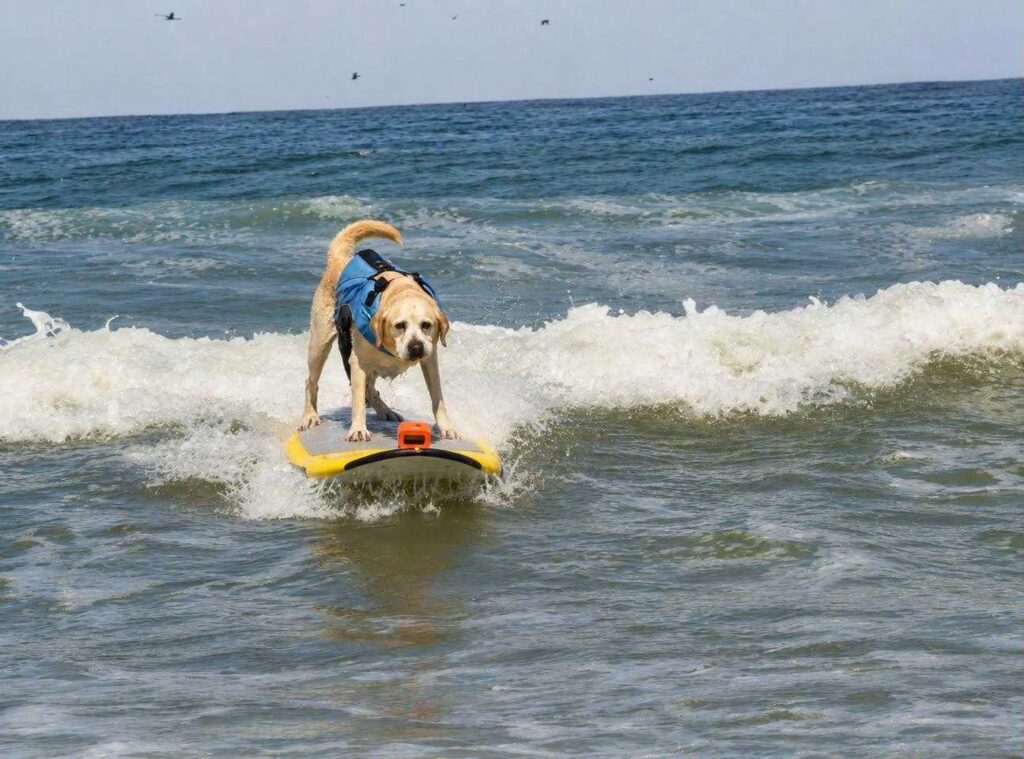
Indeed, he is. That’s Charlie, a competitive dog-surfing champ in his element.
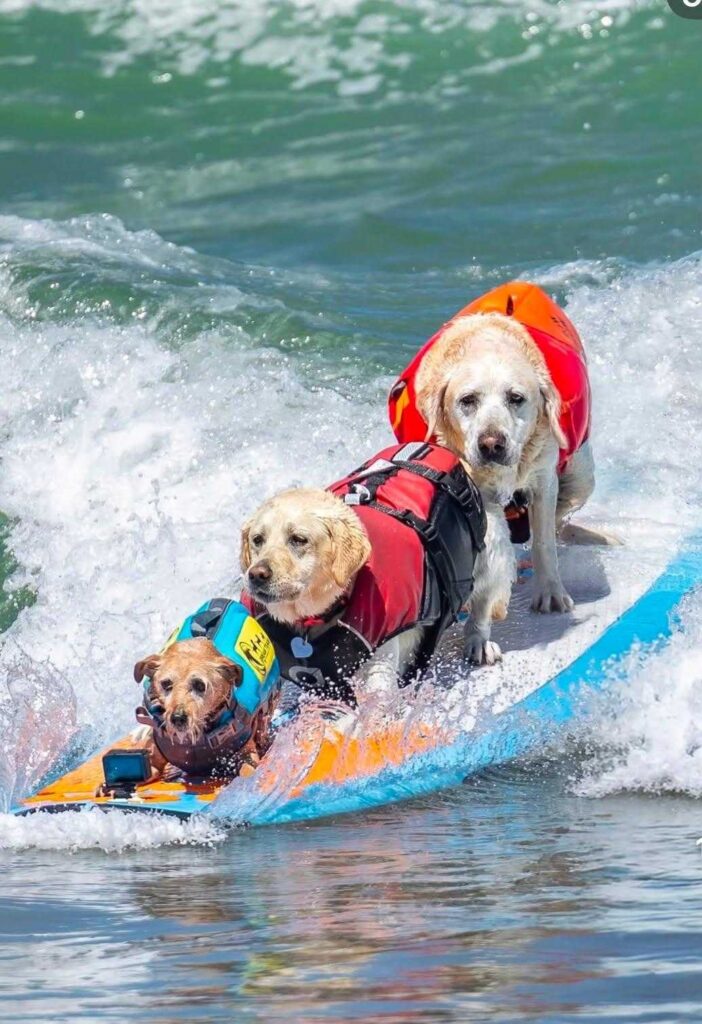
On August 1, Charlie joined a fleet of vizslas, miniature pinschers, French bulldogs, and other pooches showing off their radical skills at the 10th annual World Dog Surfing Championships. At the competition, which raises money for dog, surfing, and environmental nonprofits, canines and humans vied for carved wooden medals in categories for solo riders, person-dog pairs, and all-dog teams on a single board.
If you’re curious about starting your dog on a surf journey of their own, here’s what to know about safety, training, and how the sport can bring you even closer to your best friend.
Surfing dogs you should know
We’ve already met Charlie, an 11-year-old yellow Lab who shreds out of El Cajon, California with his humans, Jeff and Maria Nieboer. His path to surfing glory began in 2018 when Jeff’s daughter gifted Charlie surf lessons. “He did really well, and there was a competition coming up,” Jeff said. “So we started working with Charlie more on the surfboard.” Over six weeks, they began practicing at home before hitting the beach, catching small waves at first. He continued to progress, “and was having a good time doing it.”
In the 2018 Imperial Beach Surf Dog Competition—his first competition—Charlie took second place. From there, they were hooked, entering four more events that year.
Canine surfers don’t tend to be groomed from birth for greatness—mostly, they’re ordinary dogs whose people find out they love to be on the water. “I didn’t wake up at 51 and say, ‘I’m going to surf my French bulldog, and we’re going to be number one,’” said David Fasoli of Pleasanton, California. His Frenchie, Iza (pronounced EYE-za), has spent five of her six years surfing the West Coast with Fasoli.
Fasoli adopted Iza during COVID lockdown, and would walk her on Santa Cruz’s empty beaches. One day, he brought a skimboard (a type of small surfboard) and she jumped on, balancing as the ocean ebbed and flowed. So Fasoli worked with her little by little on swimming and surfing skills, eventually entering competitions. She placed first in the medium dog category and second overall in the World Dog Surfing Championships.
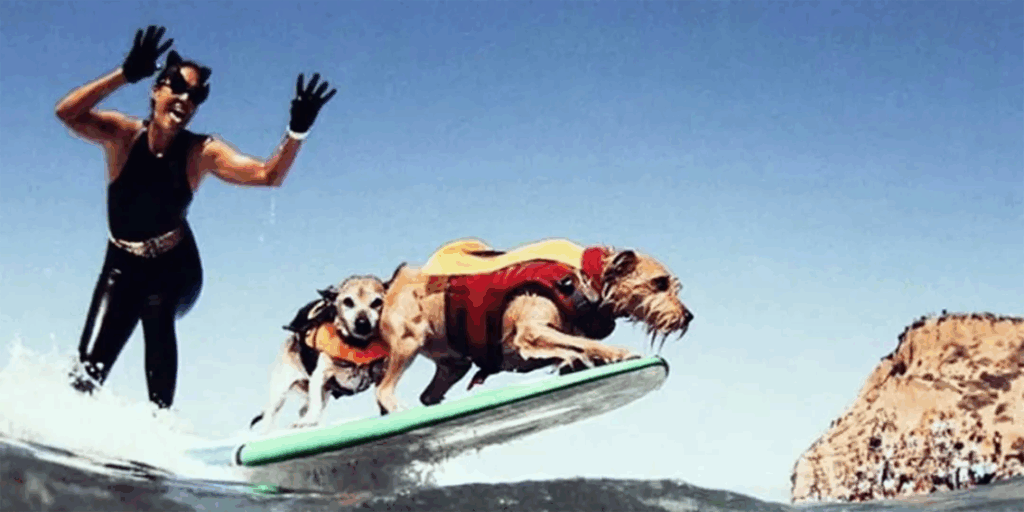
Also present at the Championships was Jill Nakano of Long Beach, California, who started training her dogs to follow in the foamy wake of her first surf dog, a rescue from Maui named Kihei who first followed her into the surf at Huntington Dog Beach in 2002. In 2014, when Kihei was 12 years old, Nakano knew she wanted a puppy as his companion and successor—so she found Carson, a miniature pinscher silky terrier mix.
Now 12 years old, Carson has a protégé of his own: 17-month-old Bradley “Shortboard” Cooper, a mixed-breed rescue nicknamed for the type of board he rides (and, yes, regular-named for the actor). This year Bradley debuted in the Championships, where he and Carson came in first and second place respectively in the small dog category, and Bradley took third overall. In addition to raising Bradley and Carson, Nakano is a surf instructor certified by the National Surf Schools and Instructors Association. Though her certification is for teaching humans, she also helps other dogs ride the waves.
“It was always my dream to surf with my dog,” said Steve Drottar, a prosecutor from Santa Cruz and competition partner to Rippin’ Rosie, his 5-year-old yellow Lab. This year, the duo took first place in the human/dog tandem and standup paddleboard categories, and Rosie won first overall.
While some of these dogs compete against each other, they’re not rivals. Rosie, Carson, and Charlie even surf together as the Dream Team, and took second place in dog/dog tandem.
Of course, the main prerequisite for any surfing dog is that they are interested in the activity. “Stoked” about it, if you will.
Do dogs even like surfing?
Maybe you’re skeptical that dogs enjoy riding the undulating sea on a plank, but these dudes and dudettes make it obvious that they do.
Over years of surfing, Maria and Jeff learned they must hide Charlie’s board from him until it’s time to hit the water. Otherwise, once on the beach, he’ll grab it and try to drag it to the ocean unsupervised.
Another surfing dog, a rescued pit bull named Faith, can’t contain herself when surfing is on the horizon. “She knows exactly what’s happening when the boards come out,” said her owner, James Wall of San Diego. “She gets excited as soon as we start loading the car, barking and whining with excitement.”
One of Drottar’s Instagram videos features Rosie jumping for joy at the suggestion of surfing. For working breeds, this sport can be a type of enrichment. “For a working Labrador like Rosie, this is her satisfaction,” Drottar said.
Iza shows Fasoli her own signs of excitement: When he gets the board out, “she does a little dance” by running in circles, he said.
How can I teach my dog to surf?
As novel as it seems, surfing is a trainable skill—albeit one comprising many smaller skills. With regular practice, positive reinforcement, and a dog-first approach, you may be able to take your dog from “paw” to “hang ten.”
- Make sure your own skills are up to snuff.
If you want to surf with your dog, you’re probably already surfing on your own. It’s crucial that you’re confident in your own abilities so that your dog trusts you. But if you’re teaching your dog to surf solo, then all you need is good enough swimming abilities to look out for them if they run into trouble.
- Teach them the basics.
To state the obvious, surfing is not the first skill you should teach your dog. They’ll need a foundation.
Before they set paw in water, make sure your dog knows essential cues that will keep them on the board. “It helps if you start with a dog who can sit and stay,” Jeff said.
As you and your dog build trust and communication skills through training, you’ll be able to read each other better. Drottar and Rosie worked at obedience and obstacles at a training school before hitting the waves, “so Rosie had trust in doing something with me besides just going for a walk,” Drottar said.
Whether or not your dog practices water sports, training is a great way to enhance your bond, as useful on dry land as it is on the water.
- Introduce them to the beach and water.
Start taking your dog to the beach regularly. Accustom them to this salty, sandy venue with walks and fetch. Successful surfing means the beach, including the ocean, is a happy place for them. The beach poses its own dangers to dogs, such as the risk of overheating or ingesting salt water and other foreign objects, said Kaitlyn Krebs, DVM, Diplomate of the American Board of Veterinary Practitioners (canine/feline), clinical professor of primary care at Rowan University’s Shreiber School of Veterinary Medicine. You must also watch out for items that might hurt their paws or paw pads.
Excessive salt water ingestion, according to Cornell University’s Riney Canine Health Center, “may cause dogs to feel thirsty and react by drinking more water than normal. Negative effects include vomiting, diarrhea, and lethargy.” Learn more about keeping your dog safe at the beach here.
With swimming, start in calm, shallow water, like a pool, and be sure they’re always wearing a life vest. If they take to it, proceed according to their comfort level. Treats, toys, and praise always help create positive reinforcement around this new activity, but don’t force it if your dog isn’t having fun. Learn more about teaching your dog to swim here.
If at any point in this process your dog doesn’t seem into it, or shows signs of fear or anxiety such as a tucked tail, widened eyes with visible whites, shaking, or freezing, stop. Whether your dog’s done for the day or never wants to step in a body of water again, respect their wishes.
- Get them on a board in flat water.
Once they’re comfortable with swimming, break out a board so they can learn to balance in flat water. Jeff suggested “playing catch” with another person as you gently push your dog on the board across the pool to each other so they learn to stand on a moving surface.
- Practice on dry land.
As they gain confidence with water, head inside to practice standing on an unstable surface, a technique Drottar and the Nieboers used with their dogs. This simulation will help prepare them for balancing on moving waves. Place your board on a pillow and have your dog stand on it.
- Catch the smallest waves.
Once your dog is game to venture into the ocean, begin with the smallest waves. Use their life vest, and practice far away from other surfers to avoid collisions with runaway boards, said dog trainer John Hawk, CTC. Remain calm every step of the way: “If the [owner] is nervous, the dog will be nervous,” Maria said.
Fasoli echoed this message. “Make sure you’re confident and comfortable in the water,” he said, “and then your dog will follow.” Only progress to slightly bigger swells when they seem confident, handling the tide with ease, eagerly tackling the next wave, and learning to shift their balance to stay on board.
In competition, dogs require two people out in the water. One acts as a launcher who sends the dog out on a wave; the other a retriever who ensures they glide safely to shore. Use this model so somebody has eyes on your dog at every stage of the surf.
At this point, many routes are available to you and your dog. Surfing’s great, but you can also try standup paddleboarding in any body of water, skimboarding on shore, or swimming together. Of course, if your dog jumps on their board over and over, cruising through every wave, you can check out any number of dog surf competitions—but leave it up to them.
Wall of San Diego never pushed Faith. “The biggest thing was letting her decide the pace,” Wall said. “I never forced her to do anything. If she wasn’t having fun, we’d stop. Surfing was always supposed to be something we enjoyed together.”
Is it safe for my dog to surf?
Whether surfing is safe for your dog depends on their particular abilities and interests. If you’re not sure, talk to your vet about it. This goes for any new exercise routine.
That said, as is the case for humans, safety is paramount even for dogs who are well-suited to surfing. Their well-being—both physical and emotional—should always be the top priority.
“Dogs who love surfing and water are so fun to watch, but make sure the dog enjoys doing the activity,” said Dr. Krebs. “If an owner pushes a dog to surf and the dog is nervous or anxious, it might not be the best sport for that dog.”
Here are the musts of surf safety for any dog who’s trying the sport:
- Make sure they’re a swimmer.
This rule is foundational to your dog’s surf experience. If your dog can comfortably swim in the ocean, they can safely and calmly move through the water if they fall off the board. Drottar also trained Rosie to swim toward the shore if she falls off her board and can’t find him. This way, he knows that she can get herself to safety if she’s out of his sight.
Just knowing how to swim isn’t enough; loving it is a prerequisite for surfing. If they don’t enjoy being in the water, they shouldn’t be on the water.
- Give them a life vest.
Even if your dog swims with the strength and ebullience of a sea otter, they must wear a properly fitted life vest.
- Give them a wetsuit or other warm layer (if they’re small or single-coated).
Double-coated dogs, like Labrador retrievers, were bred to swim in cold water. But if your small, single-coated dog enjoys surfing, keep them warm in a doggy wetsuit or fleece—especially if they’re in colder waters. Just make sure they can comfortably move and safely swim while wearing it.
- Use the right gear.
Human surfboards made of hard fiberglass “pose too much impact danger” to dogs, said Hawk. Dogs should use soft-top boards made of styrofoam, topped with high-traction pads for them to grip. Never leash your dog to the board; this could threaten their life if they get tangled underwater. Hawk also urged removing fins from the bottom of the board, because they could cause lacerations.
- Keep your eyes on your dog.
This is true whenever your dog is in the water, but especially if they wipe out while surfing. “Don’t worry about the board; always have eyes on the dog,” Maria said.
- Know when to bail.
Only take your dog on the water in conditions that are safe for them. Ideal waves for skilled surf dogs, Jeff said, crest between waist- and chest-high on a human; Hawk recommended sticking to swells under one foot high. Waves also must not break too close to shore, so the dog can ride smoothly onto the beach. Jeff and Maria have pulled Charlie out of competitions before because of hazardous conditions.
Beyond surf conditions, your dog must also be emotionally in the zone. Their experience comes first, so learn when they’re ready to turn in. Wall always follows Faith’s lead. “The second it stops being fun for your dog, it’s time to call it a day,” he said.
A totally righteous bond
As with any shared activity, surfing can fortify your bond with your dog in new ways.
Jeff described such a closeness that “it’s almost like you can read their mind.” This connection shines through in competition, Maria added—after a wave, spectators might rave about something that she didn’t even register because she was so focused. She added that dogs tend to perform the best when their person “is really in tune with them.”
Rosie and Drottar vibe on the same wavelength. “It’s one thing to take your dog for a walk; it’s another to go out and accomplish something as a team,” he said.
Knowing your dog can rely on you out on the water can be its own reward, too. “It’s pure trust,” Fasoli said.
Part of that trust means knowing what’s best for your dog—on the waves and in life on land. Jeff and Maria decided that this year’s Championships—where Charlie ultimately placed second in the large/extra-large dog category—would be his last.
As his back legs have weakened and stiffened with age, the Nieboers decided it was time for him to retire from competitive surfing. “He still has a good time, but we know it’s hard on him—and he doesn’t understand that and won’t stop,” said Jeff. “We don’t want him to get hurt now that he’s older.” But Charlie still loves surfing, so they take him out for short, relaxed sessions.
But retirement from competition doesn’t have to mean giving up an activity that Charlie loves. This is a worthwhile lesson for any owner of a senior dog: Senior dogs all need exercise and enrichment that match their current interests and abilities.
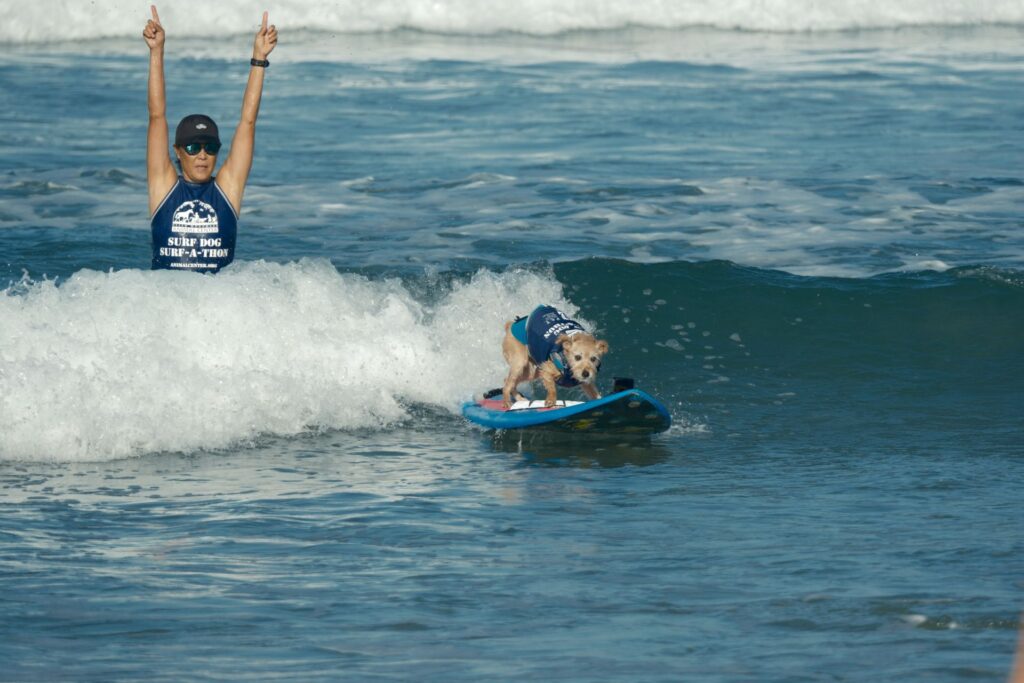
Faith—now 15, completely deaf, and living with vestibular disease that affects her balance—proves that the end of a competitive career isn’t the end of a beloved pastime. She retired last year after winning the Helen Woodward Animal Center Surf Dog Surf-A-Thon both overall and in her category. “I honestly couldn’t have asked for a better ending to her competitive career,” Wall said. And they still surf for fun together.
Looking back at Faith’s surfing career, Wall told us, it was never about winning. “After all these years, we just kind of understand each other,” Wall said. “Some of my favorite memories aren’t even from competitions—they’re just the days when it’s me, Faith, a surfboard, and the ocean, having fun together.”
The post Surfin’ D-O-G appeared first on The Farmer’s Dog - Digest.
Comments
Post a Comment