In this article:
- What’s the difference between fear and anxiety in dogs?
- What causes anxiety in dogs?
- How can you tell if a dog is anxious?
- What can you do to help a dog overcome their anxiety?
- Can exercise and enrichment help a dog with anxiety?
- How should you handle farewells and greetings to help a dog with separation anxiety?
- How can you build up an anxious dog’s confidence?
- Can management help an anxious dog?
- Is it okay to comfort an anxious dog?
- Can desensitization and counterconditioning help an anxious dog?
- When should you call a veterinary behaviorist to help an anxious dog?
- Can medication help an anxious dog?
- Do senior dogs often become anxious?
- How can you prevent a dog from becoming anxious?
- Can dogs get over their anxiety?

Nicholas Dodman, BVMS, DACVA, DACVB, a professor emeritus at Tufts University who’s spent much of his career studying dogs’ behavior, told us about a dog he once treated who was petrified of trash day.
Sanitation workers came in their trucks and picked up the garbage each Tuesday, and the dog’s worry began the night before. The dog’s owner told Dr. Dodman that her dog started to show signs of fear on Monday, when she put the bins out. By Tuesday, she said, he was “absolutely terrified.”
This dog wasn’t merely fearful. Because he was so uneasy about an impending misfortune—big, loud garbage trucks that weren’t there at the moment, but could soon be on the way—he was anxious.
Here’s how to identify anxiety in dogs, help your dog if you think they’re suffering from it, and make it less likely in a dog you’ve brought into your life.
What’s the difference between fear and anxiety in dogs?
Maddie Messina, a certified dog trainer and founder of Paws for Thought Dog Training, told us that “fear is an innate response to something threatening. Anxiety is the more general prevalence of fear, or the consistent fear, of something that could happen in the future.”
Katherine Houpt, VMD, PhD, a professor emeritus of behavioral medicine at Cornell University, put it this way: “Fear is usually when there is something to be afraid of.”
Dr. Dodman compared an anxious dog to a person who you’d describe as “a worrier.” Elaborating, he said that “they’re on edge the whole time. In biological terms, their sympathetic nervous system [which controls the body’s “fight-or-flight” response] is in overdrive.”
Dogs can have various types of anxiety. Among others, these can include separation anxiety, which is triggered by their caretakers’ departure; anxiety about noises; and generalized anxiety.
Dr. Dodman also talked about phobias, which are a type of anxiety. He described a dog who has a strong reaction to other dogs. “Every time he sees another dog,” he said, “he goes absolutely spinning crazy. He doesn’t wait to decide whether it’s good, bad, medium, indifferent. That dog has a phobia of other dogs. ‘Fear aggression’ is what veterinarians would call it—but actually, in that case, it’s a dog phobia.”

What causes anxiety in dogs?
Messina described a process of sensitization that can turn fears into anxiety.
“A dog can have a fearful response to fireworks,” she said. “But when it turns into noise-based anxiety is when small noises set the dog off—noises in the hall, the fire alarm, the beeping of an oven.”
Early life experiences matter, too. Dr. Dodman talked about the importance of stability for a puppy. “When, as a young pup, a dog has their mom as their primary attachment figure, they nurse on her… If they stay with their mom long enough, and they’re comfortable enough and start to be a little independent, and then they’re adopted, they have another reliable owner who takes care of them—there’s very little breakage in the bond of attachment to a sort of parental figure.”
He said that the above arrangement is ideal and would make separation anxiety less likely when a dog grows up, but that it’s not always possible. He gave one example: “If a [puppy] gets severe diarrhea and has to go to the veterinary office, where they’re kept in a metal cage that can be easily cleaned out while they’re treated for parvovirus… that dog can go back to a family, but now they’ve had this attachment bond broken.” This could make the dog more vulnerable to separation anxiety in the future.
A lack of proper socialization during a dog’s early weeks can have an impact. Research shows that dogs who don’t have those early, happy encounters with a variety of stimuli can be more prone to fear and anxiety. Expose your puppy to as many safe, positive experiences with people, animals, objects, and environments as you can during their socialization window, which lasts from around 4 to 16 weeks of age. Talk to your veterinarian about how you can safely give your dog this socialization while protecting them from illness, especially before they’ve had all of their shots. Usually their recommendations will include restricting interactions to known dogs who are up-to-date on their vaccines.

How can you tell if a dog is anxious?
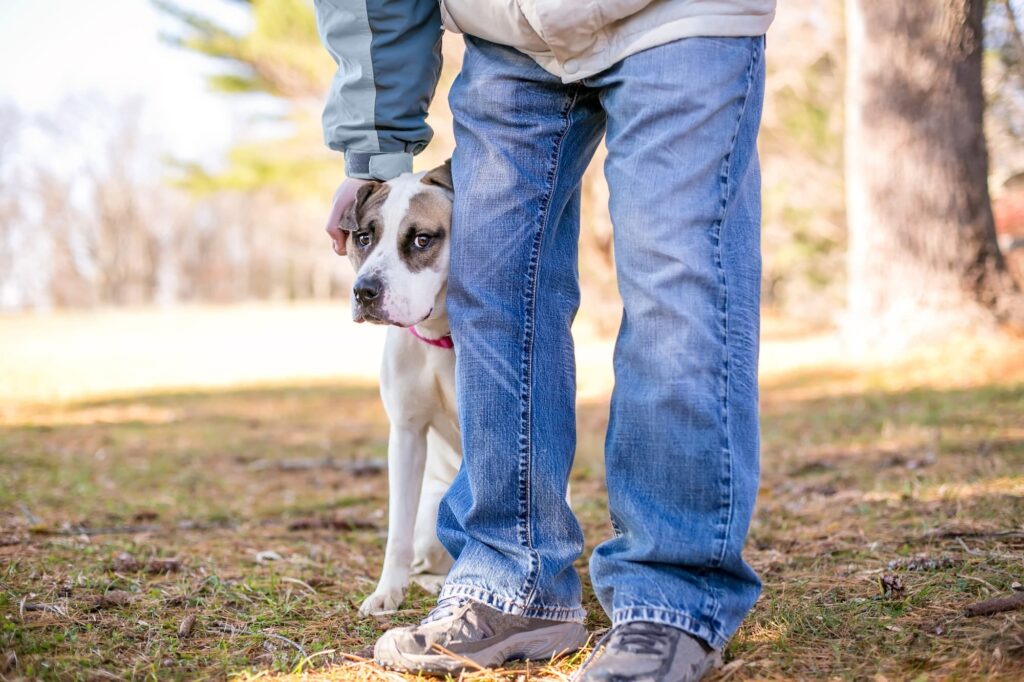
You can’t help an anxious dog unless you first notice that they’re anxious, so it’s important to watch them for behavior changes. The experts we spoke to named these among the possible signs of anxiety in a dog:
- Panting
- Shaking
- Restlessness/inability to settle
- Ears back
- “Whale eye” (visible whites of eyes)
- Pacing
- Wet footprints on a metal surface at the vet, which may indicate sweating from the paw pads
- Destructive behavior or incessant barking when you leave
- Nosing at you for attention more than three times an hour, even if you give them other entertaining things to do
Messina told us that, when it comes to anxiety, these behaviors may “show up in contexts where the trigger isn’t even present.” Think about the dog from the introduction of this article, who started to worry about the garbage trucks the night before, when he saw the bins going out.
What can you do to help a dog overcome their anxiety?
Desensitization and counterconditioning, exercise and enrichment, and medication are among the tools that can help dogs with anxiety. Here are some detailed tips.
Make sure your dog gets enough exercise and enrichment.
One 2015 study in Finland found that “the largest environmental factor associating with noise sensitivity and separation anxiety was the amount of daily exercise; dogs with noise sensitivity and separation anxiety had less daily exercise.”
“Exercise generates serotonin,” Dr. Dodman said. “It’s a mood stabilizer. So if your moods tend to swing, as they do with a separation-anxiety dog, from joy to misery, it will even out those rollercoaster rides.”
Dr. Dodman remembered a dog he had, who lived to 16. “He was a wonderful dog,” Dr. Dodman said, “but he had separation anxiety when I rescued him.” He and his wife tried to be with their dog as much as possible, but when they had to leave they took extra care to give him adequate exercise. Dr. Dodman gave this example of their routine before a 6 o’clock dinner out with friends. “I’d take him out at 3:30,” he remembered, “running off leash, chasing a ball, swimming, doing everything for at least an hour. So he was already tired and generated a lot of serotonin.”
Messina echoed Dr. Dodman’s point. “Our dogs, especially in the city, can potentially live very small lives compared to the life they could have been living 100 years ago,” she said. That’s one reason that boredom is a hazard for many pet dogs.
As such, said Messina, “exercise and enrichment are always going to be a part of the plan” for an anxious dog.
Dr. Dodman encouraged owners to “think about the five senses” when giving their dog enrichment, and to consider their dog’s individual needs. Different tastes, sights, smells, sounds, and textures can keep dogs’ lives more interesting. Puzzle toys or edible chews can help. Some dogs like to watch television. Some like to look out the window or listen to music. Find what seems to interest and please your dog, and don’t force anything on them if they don’t like or care about it.
Stay calm when you leave and return, and make your absences more fun.
One way to help a dog with separation anxiety is to make it clear that it’s not such a big deal that you’re leaving or coming back.

“There is no reason to ignore [your dog],” Dr. Dodman said, “but you shouldn’t bring them on this emotional rollercoaster where you are behaving as if you just came back from war.” If you make it routine to calmly leave and let your dog settle down when you return instead of being too effusive upon walking back in, that sends the message that leaving and returning is unremarkable. “The idea,” he said, “is to try and level out the peaks and the troughs so you get a much more stable relationship and existence with the dog.”
He recommended giving your dog food when you leave—saving, for example, half of their meal to serve while you’re on your way out.
Dr. Houpt said that you can make separations easier to handle by ramping up how long you’re gone instead of leaving for four or five hours without any practice. “You teach the dog to sit and stay,” she said, “and then gradually increase the amount of time he has to stay. Of course,” she said, “he gets the food reward, if that’s what he likes.” Once the dog can stay for a minute, she said, you can step out of sight and then come right back and reward them. “You’re trying to get the dog to withstand your leaving for a few minutes,” she said. “Usually, once they do that, they’re good for longer periods.”
Build your dog’s confidence.
Messina talked about the benefits of training dogs to feel more in control and confident. She gave the example of the “push behavior,” which she’s found useful for some dogs with noise phobias.
“You teach the dog to push something with their nose or paw,” she said, and when it lands it makes a sound. “You start with lower-intensity things, like a plastic tube onto a rug.” Then you could progress to “a water bottle on a wooden floor,” for example. “You’re giving the dog a little bit of control over making noises,” she explained, “and turning it into a fun game.”
In trying this game, you should only move forward at your dog’s pace. “If you level up the dog and you see a big fear response,” she said, “they are less likely to want to do the behavior again. That’s when you have to take a step back and say, ‘Okay, we’re going to go back to something easier.’”
She recommended varying the difficulty even once your dog has advanced. “If things only ever get harder,” she said, “it can potentially diminish interest in continuing.”
Dr. Houpt said that your behavior should make it clear to a dog that they don’t need to worry around you. Take a dog who might be resource-guarding because they’re nervous that you’ll take their food away. “If you’ve never taken food away from the dog,” she said, “they’re actually pretty unlikely to show that behavior.” Because, of course, you may sometimes need to take something away from your dog that they shouldn’t eat, Dr. Houpt recommended training them “drop it” and “leave it” with positive-reinforcement methods.
Manage your dog’s environment.
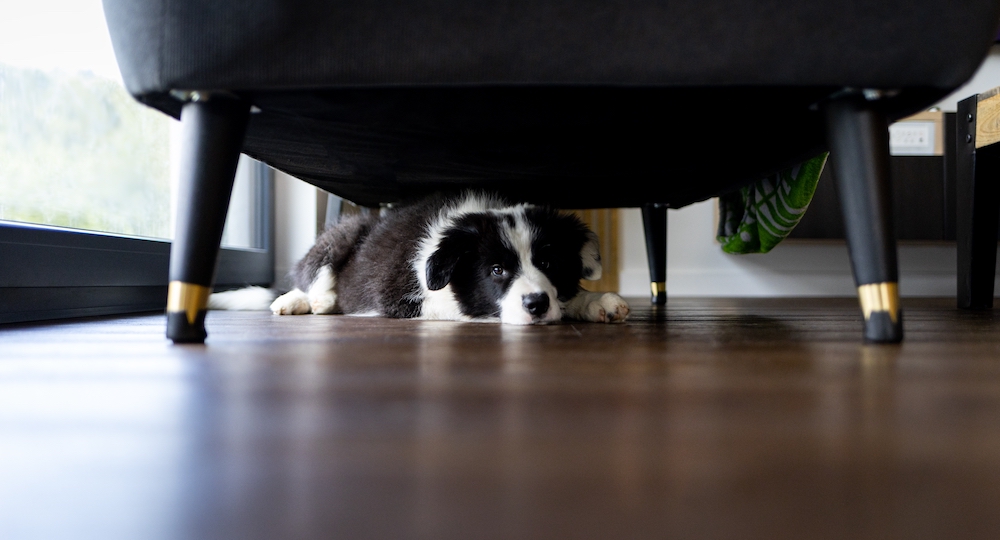
When we wrote about how to help a fearful dog, we said that it’s fine to avoid your dog’s fear triggers if possible. If you know your dog is afraid of loud noises, for example, you can avoid construction sites on your walking route.
Plan ahead—if you know a thunderstorm or fireworks display is coming, for example, you can put your dog in a safe, comfortable room away from the noise with a fun distraction to occupy them.
Messina compared this to the way someone with a fear of flying might prepare for a flight. “I wear my noise-cancelling headphones,” she said. “I take my medication. All of that can be preplanned and practiced, which we recommend.”
If your dog asks for comfort, give it to them.
Petting your dog and telling them everything will be okay is far from a panacea, but it’s a myth that doing so will make their fear or anxiety worse. That thinking is based on the idea that if you reward a behavior, you’ll get more of it. But fear and anxiety aren’t behaviors—they’re emotions. So if your dog wants affection during a difficult moment, go ahead and provide it. It will show them that you’re there for them.
As Messina told us for that earlier article about fearful dogs, “If your child were struggling, you would probably reach down and help them feel a little bit better, work through that moment—and it’s totally fine to do that with your dog as well.”
Use desensitization and counterconditioning.
Desensitization and counterconditioning are the best tools to help a fearful dog, and are vital for dogs with anxiety.
In her book Wag: The Science of Making Your Dog Happy, Zazie Todd, PhD, a psychologist and certified dog trainer, defined them this way:
“Desensitization means presenting the stimulus at a very low level that the dog is happy with, and gradually increasing it so the dog becomes used to it (the opposite of sensitization). In counterconditioning, every single presentation of the stimulus is followed by something the dog likes (such as chicken or cheese) so the dog learns the stimulus predicts good stuff happening.”
The idea is to find a small component of what makes your dog upset and present it to them at a low enough intensity that they can be calm and happy around it (this is part of the desensitization process) then give them a reward for that (this is the counterconditioning—associating the trigger with something they like).
Make sure that your dog is “under threshold,” meaning that they’re showing no signs of stress and are happy to follow cues and receive treats. If they can’t do that, trying to force them could make their anxiety worse—and they’re not going to learn anyway.
“If you hung someone by the back leg off the Empire State Building,” Dr. Dodman explained, “and you say, ‘Would you like a cheese and pickle sandwich?’, The answer would be ‘Not right now, thank you.’ Your appetite immediately disappears in an intense fear situation.”
So go at your dog’s pace, and back up if they show signs of stress.
Call a veterinary behaviorist.
If you run into challenges you can’t handle on your own, it may be time to call a trusted trainer, veterinarian, or veterinary behaviorist. The latter will likely have seen many difficult cases, and may be able to assist you with strategies you hadn’t thought of yourself.
If they need it, consider medication.
While in most cases trainers and behaviorists will try training and enrichment-based methods first, medication can benefit some anxious dogs. If your veterinarian or veterinary behaviorist thinks medication is right for your dog, they’ll explain your options. Don’t be shy about asking questions and exploring what’s best for your pet.
Do senior dogs often become anxious?
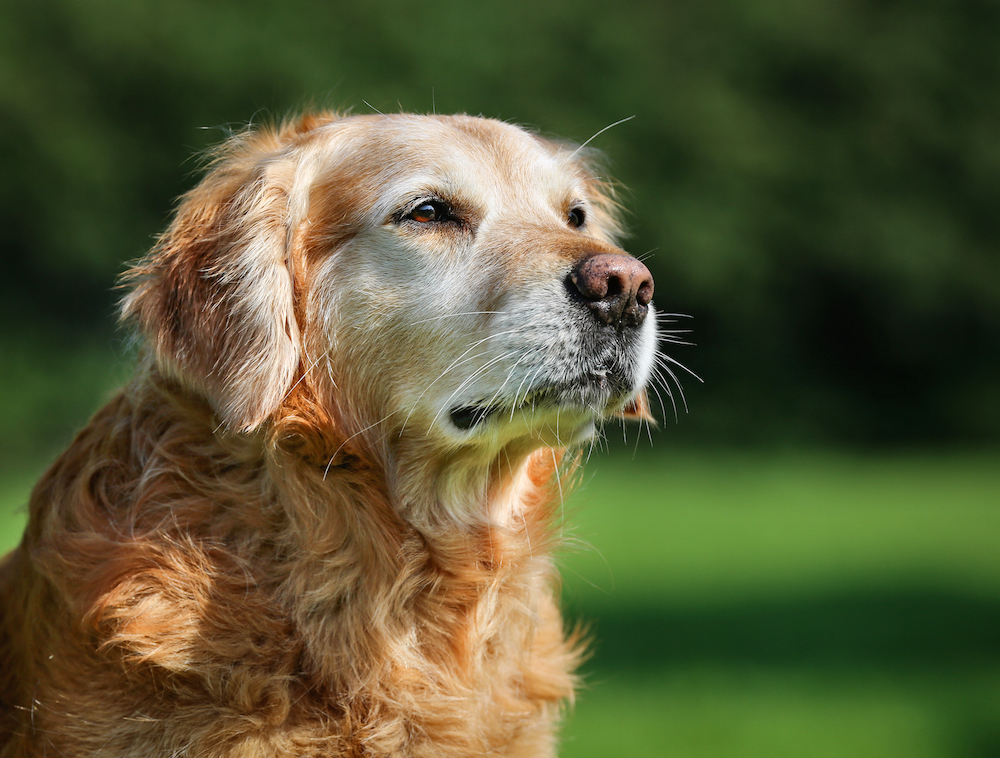
Older dogs sometimes start to show signs of anxiety even if they haven’t before.
Dr. Dodman recommended finding exercise and enrichment that’s appropriate for your dog as they get older, rather than simply reducing activity.
He remembered that his most recent dog “was very active, running around, chasing, swimming, doing all kinds of things” in his younger years. “But as he got older, we’d take him to a beautiful lake, we’d go about 200 yards and he’d go, ‘I’m done.’”
Dr. Dodman didn’t try to make his dog walk any farther than he wanted to. But he made sure there were activities to stimulate his mind, which was still active and intelligent even though his body didn’t have the same stamina. “He got all kinds of environmental enrichment,” he said, “whether it was attention, games, toys, or long-acting food puzzles.”
If you notice any change in your dog’s behavior, including new signs of anxiety, Dr. Dodman said to call the veterinarian. “If you’ve got a dog who’s over 10 who all of a sudden starts to show increased anxiety,” he said, there may well be a medical reason. These can include cognitive dysfunction, or an injury or illness that is causing them physical pain.
Can you prevent anxiety in a dog?
There’s no way to guarantee that a dog will be free of anxiety, but there are steps you can take to improve their chances of a calm and happy existence.
As noted above, if you have a puppy, you can give them the socialization they need during that critical period from 4 to 16 weeks of age. “If you want your puppy to do well,” Messina said, “you need to take them for regular outings multiple times a day. It’s not just one big walk. This puppy is getting placed on the ground and getting to explore different environments, hear sounds, and see things. That’s my number-one recommendation for every puppy client that comes through my doors.”
It’s also a good idea to get as much information as you can about your dog’s life before they came into your home.
Dr. Dodman told us about his previous dog’s history, and how it may have primed him for separation anxiety in particular: “My dog was in a halfway-house situation,” he said. “He was rescued from Texas, went to another rescue, and then was shipped up to [another rescue in] Massachusetts, where they went to a halfway house—and then came to us. This is the kind of background you get for separation anxiety.”
Knowing a dog’s early life experiences can help you decide whether they’re the right fit for your life and the place where you live, and prepare to care for them if they are.
Messina said that some of her most challenging cases are dogs whose well-intentioned owners brought them into lives where they faced too many triggers and weren’t getting the support they needed. Some of these dogs have a difficult time living in New York City, but might have had it easier in a less-hectic place.
Before rescuing a dog, Messina said, you should ask questions. “Get as much information about the dog as possible. I think that’s going to give you a much better understanding of: Is this dog going to be well-equipped for my living environment?”
Can dogs get over their anxiety?
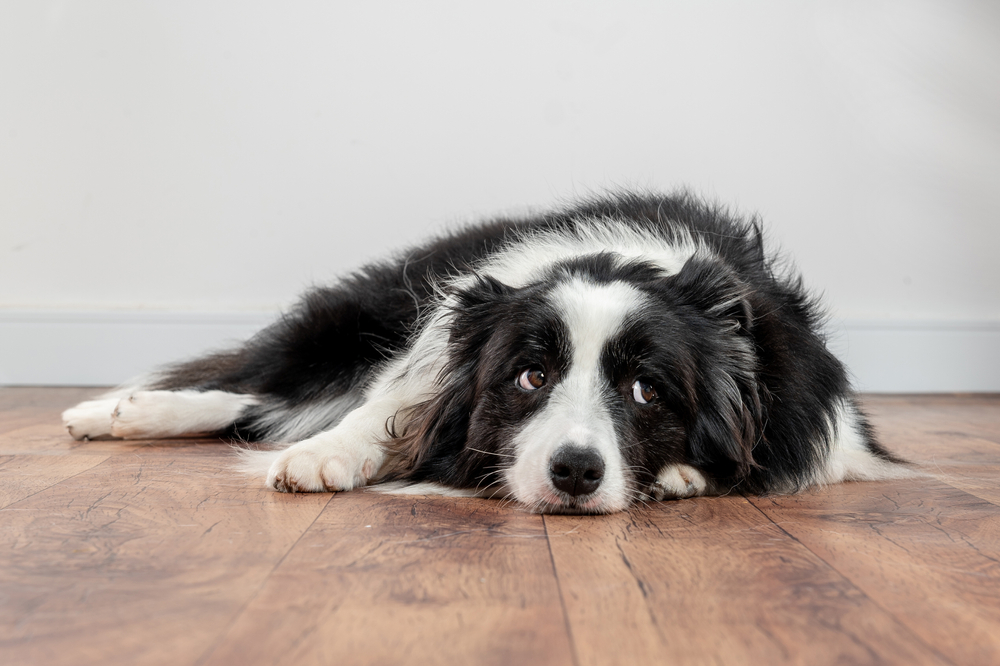
It can be upsetting to see your best friend struggle with worry. But, with support, many anxious dogs live happy lives.
Dr. Dodman told us about how he worked with the dog we introduced at the start of this article.
He used management, talking to the sanitation workers and asking them to pick up the bins a little farther away from the house. “They realized there’s a dog in there who was afraid of their truck,” he said, “so they were careful with their air brakes. They stopped farther back down the road.”
He also used desensitization and counterconditioning. “I had the owner bring the dog to the depot where the garbage trucks were,” he said, “and work with a food treat at a distance from the garbage truck.” The dog kept getting closer to the trucks—at his pace, only when he could do so without showing stress—receiving his favorite treat each time. The distance went from 50 to 25 to 10 yards.
Eventually, Dr. Dodman said, the dog met the sanitation workers, who gave him treats. Soon, the dog could jump into the cab with them.
“So now the dog was desensitized to the truck,” Dr. Dodman said, “with the engine running, and the truck was pulling up farther down the road—and the problem on Tuesdays was solved.”
These processes take time and effort, but they can work. The first step is to recognize that your dog has a problem. To do that, you have to watch them and take any signs of stress seriously.
“A dog can’t tell you that he’s anxious or what he’s anxious about,” Dr. Houpt said. “If he’s doing something that seems unusual, you should probably seek professional help. Don’t let the dog suffer.”
The post How to Help an Anxious Dog appeared first on The Farmer’s Dog - Digest.
Comments
Post a Comment