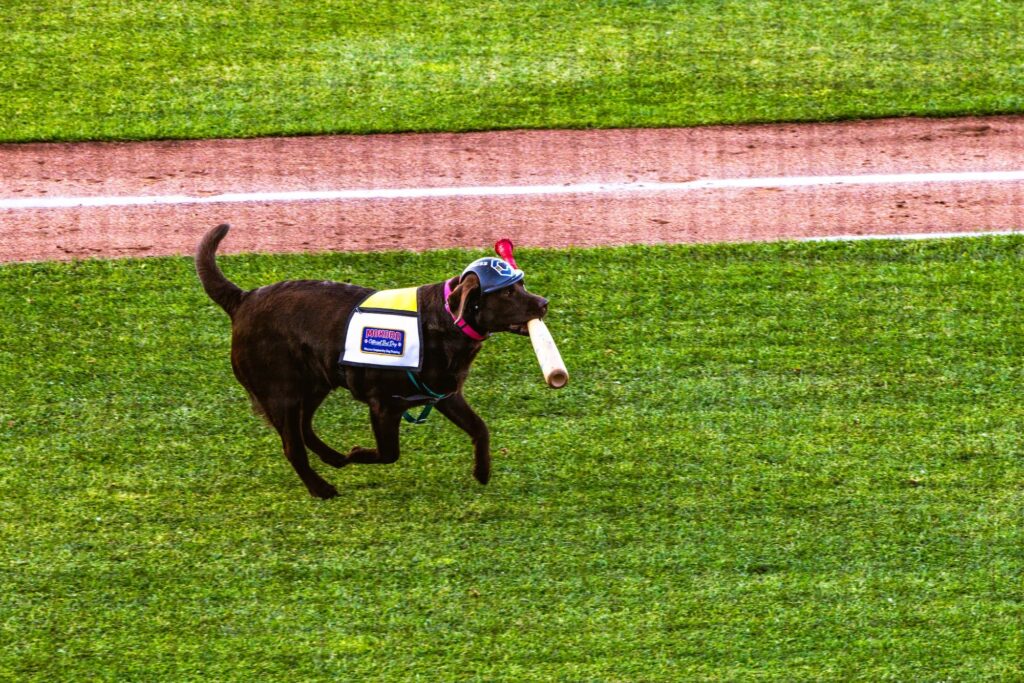
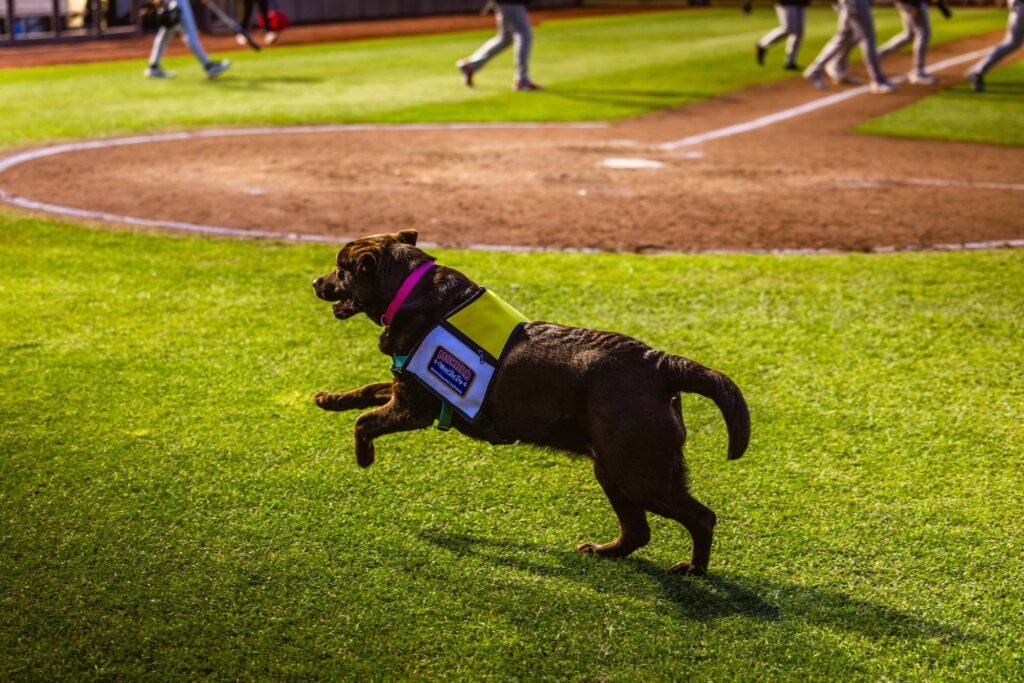
Many dream about a life in professional baseball, but Mokoro is one of the few who’s achieved it. And the 2-year-old chocolate Lab is thrilled to be the bat dog for the High-A Lake County (Ohio) Captains.
“When I take her helmet out,” said Mokoro’s guardian and trainer, Victoria Brody, “she gets the little tippy taps with her feet and I’m like, ‘Do you want to play baseball?’ She gets amped. Pretty much the whole car ride from my house to the stadium, she’s whining with excitement because she loves her job so much.”
Mokoro’s joy is contagious, and when she retrieves the bat after a Captains hit she often gets louder cheers than the hit itself. Here’s how she got the job, how she’s getting in shape, and what Brody hopes she can teach fans and dog people everywhere.
Born to retrieve
Brody has had Mokoro since she was a young puppy, and from the beginning she showed an aptitude for her future profession.
“From the start,” Brody said, “[Mokoro] was retrieving. Not bats, but balls, toys, you name it—it was in her mouth and she was bringing it to me.”
This is not unusual for retrieving breeds. A 2022 study found retrieving to be the most heritable trait among dogs tested. And when we spoke to Stanley Coren, PhD, Professor Emeritus at the University of British Columbia, about why dogs bring things to people, he recalled seeing untrained 6-week-old golden retriever puppies already displaying retrieving behavior.
So when Brody had the opportunity to train Mokoro to be a bat dog, she was starting from a solid foundation.
Taking advantage of Mokoro’s natural inclinations, Brody, who runs Mission Empawthy Dog Training—an organization that uses positive reinforcement to train psychiatric service dogs—set out to prepare her for a more formal role. For her safety and the players’, Mokoro had to learn to only retrieve a bat when given a certain signal. She had to learn to grab the bat in the right place and let it go. And she had to learn to ignore the many distractions around her at the ballpark, which is full of temptations for dogs and people alike.
“She just crushed it.”
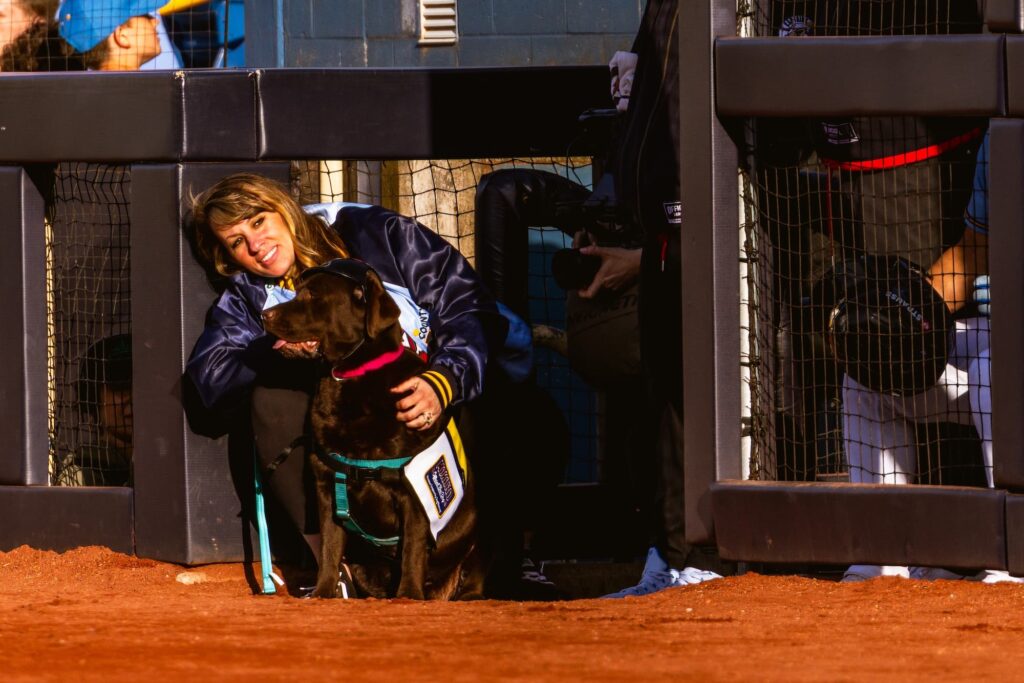
Mokoro practiced before her first game in 2025. (Per Brody, “She had to go through spring training just like the players did.”) But she’d never had a chance to do her job at Classic Auto Group Park, the Captains’ home stadium.
So when the bright lights went on, Brody had some butterflies.
“I was so nervous,” she said. But Mokoro passed a huge test on her very first bat retrieval.
“As she was running back with the bat,” Brody remembered, “one of the umps rolled the ball directly in front of her. And I’m like, ‘It’s time.’ She’s trained to ignore the baseballs. I saw her head turn, look at the ball, like, ‘Mom, I’m supposed to ignore that, right?’ I’m like, ‘Yes.’ And then she just kept running.”
It was the bat-dog equivalent of homering off Paul Skenes in your first at-bat.
“A ball, if you’re a Lab—that’s the most tempting thing in the world,” Brody said. “And she completely ignored it and just crushed it.”
A great teammate
Pitcher Jackson Humphries was a Captains rookie in 2025, debuting alongside Mokoro. “It’s hard being the only rookie,” he said, “so having someone to share that with was great.”
One of Mokoro’s best friends on the team, Humphries immediately respected her focus and saw a kindred spirit.
“She’s very process-oriented, which is great,” he said. “Super locked-in focus for super short bursts of energy and time. It’s similar to us. You’re at-bat-by-at-bat or pitch-by-pitch. Same thing. She’s a teammate.”
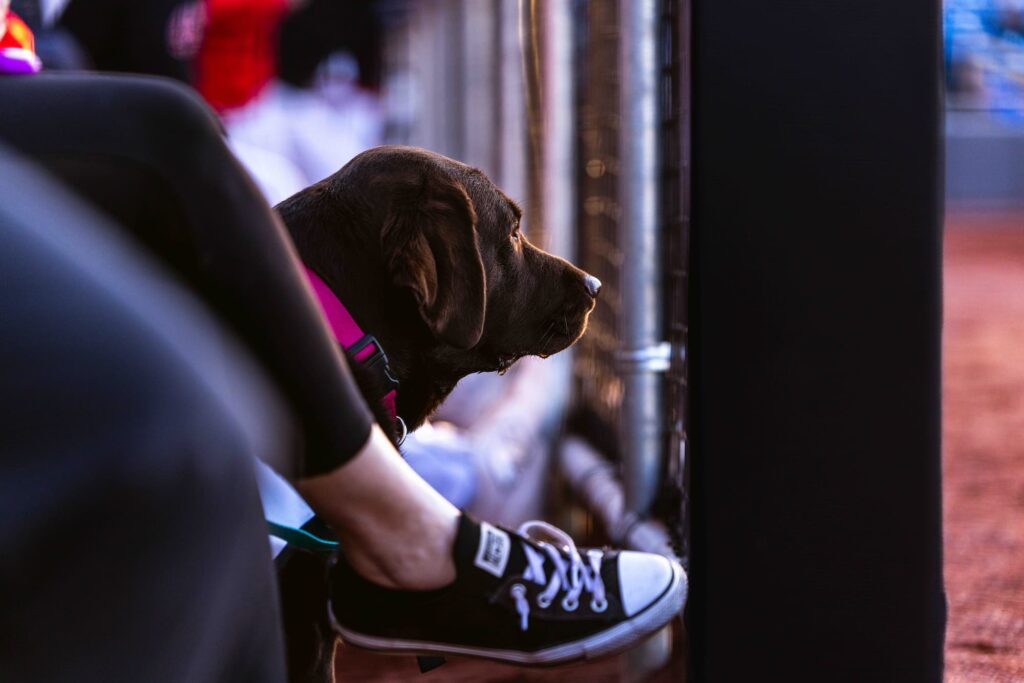
Humphries said that Mokoro’s contributions go far beyond just grabbing bats. “We all love her,” he said of the Captains’ players. “We all can give her pets. She’s always looking for attention. She sits right at the top of the dugout.”
And when the team has a big moment, Mokoro can get as carried away as anyone else.
“After the walk-off home run we just had recently,” Humphries remembered, “she grabbed multiple people’s bats. It was a big moment, so I can’t blame her.”
Safety first
Mokoro loves to retrieve, her teammates love to have her around, and the fans love to watch her ply her trade. But even so, Brody takes extra precautions to look after her dog’s physical and mental well-being.
“She didn’t sign up for this,” Brody said. “And I made a promise to her: ‘If it’s ever not fun for you, we stop.’”
On hot days, Brody said, “If [Mokoro] wants to go out for one at-bat and she’s done, that’s it.” Some days, Mokoro doesn’t have to show at all. “If I know she’s not feeling well,” Brody said, “I’ll just say, ‘Look, we’re not coming today.’”
The Captains have supported this approach. In addition to letting Mokoro tap out if she’s tired, Brody brings a cooling mat and an ice bowl to keep her water cold.
Mokoro’s helmet is not only cute, but also functional. “She always has her helmet on,” Brody said, “even when we go out to go to the bathroom on the grass outside—because we’ve actually had balls come up and fly over the stadium.”
After a high-profile incident this spring when a Double-A prospect on another team was injured avoiding a bat dog, we asked Brody what measures she takes to prevent similar issues with Mokoro. She responded in detail:
“Mokoro is only sent when play has ended,” she wrote in an email, “and the field has been cleared, and we have dedicated personnel confirming it’s safe before she ever steps onto the field, so we have an additional layer of eyes and communication to guide us. As her trainer, I’ve got eyes on her and the action, and the bat boy is on the opposite side of the dugout with a closer vantage of the bat. He gives me a thumbs up when it’s appropriate to send her and I have the ultimate veto power if something is awry (e.g., broken bat, action is still occurring, or she’s simply too tired). After I’m given the thumbs up, you’ll hear a loud verbal cue of ‘OK Bat!’ which is not only an indication for Mokoro to go get the bat, it’s a clear signal to the players of her departure from the dugout. We also always maintain the exact position in the dugout so her path of leaving and arrival is 100% predetermined and predictable. The safety of the players and Mokoro will always come before any bat retrieval.”
A healthy diet
As the 2026 season approached, Brody noticed that Mokoro had put on a few unwanted extra pounds—so we set out to help the Captains’ bat dog get into The Best Shape of Her Life.
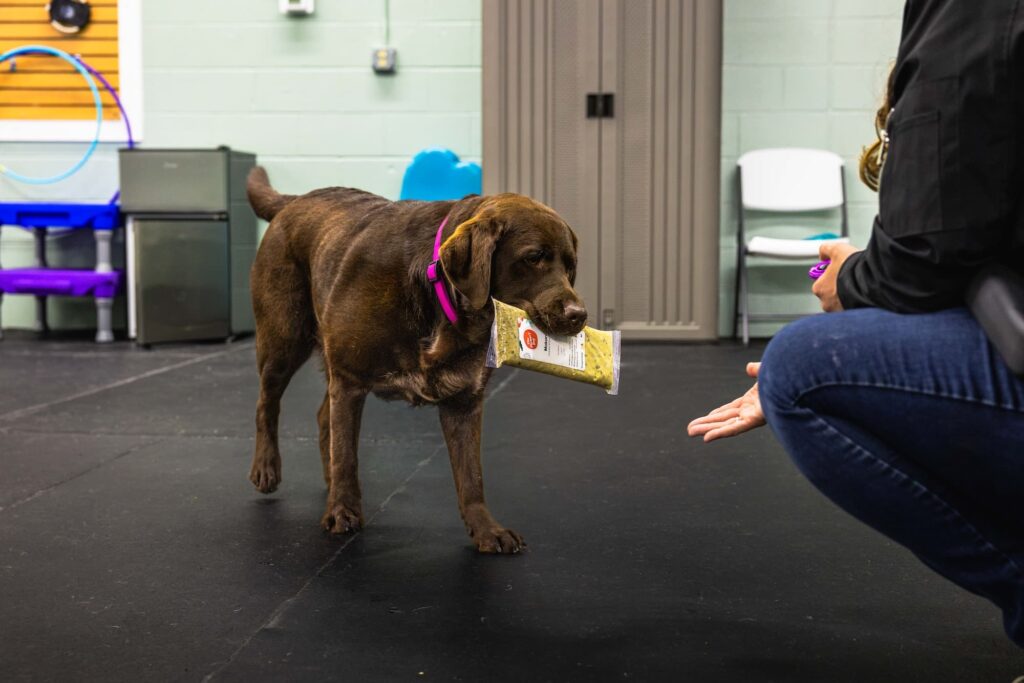
She switched to pre-portioned food from The Farmer’s Dog, and now she’s rewarded with her fresh food and Snap Sticks after she grabs bats.
“She loves the food,” Brody said. “It’s one of her absolute favorite things. She likes it even as a snack.” This is crucial, since food and snacks need to be tasty to work as training motivators.
“She’s already lost eight pounds,” Brody said, “which is fabulous. She needed to get into better shape. So it’s really helping us with portion control and with caloric intake.”
Staying at a healthy weight is important for any dog—research shows that dogs in lean body condition can live up to 2.5 years longer than those who are overweight or obese—and Brody especially wanted to get Mokoro into shape.
“Too much weight can be really bad for dogs’ hips,” Brody said, “especially when she’s moving as much as she is. We want to make sure that she’s in good condition, and right now she’s a little bit overweight. But we want to make sure she’s as healthy as she can be.”
Teaching confident dogs
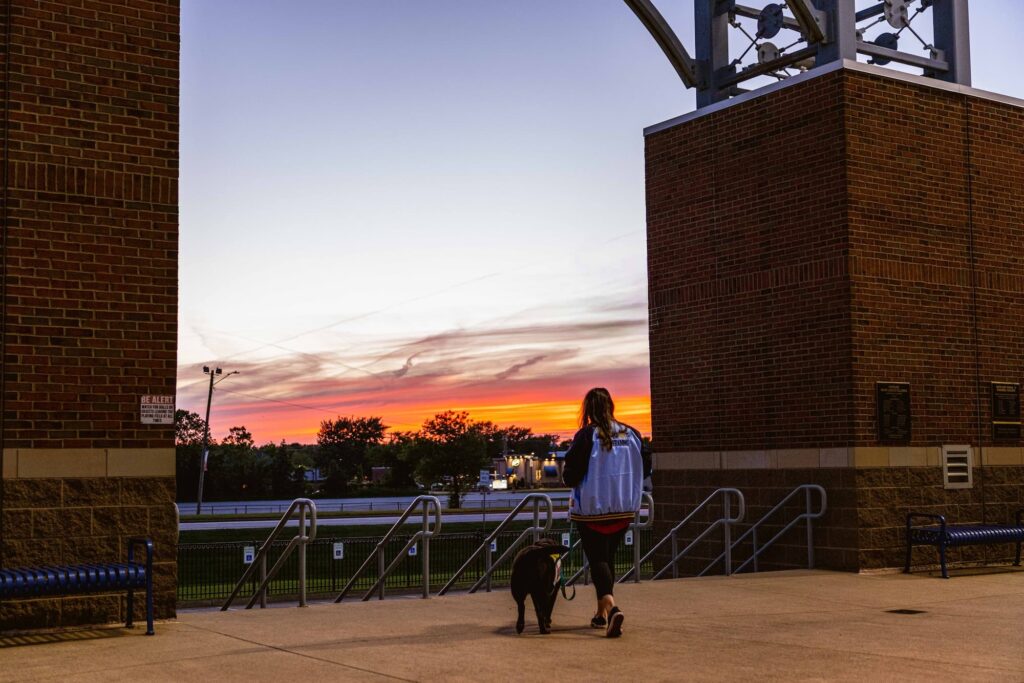
In an interview at Lake Humane Society and Adoption Center, Brody talked about how she hopes Mokoro’s amazing skills, and the ways she’s built them, can teach dog people. She’s particularly proud that she trained Mokoro through positive reinforcement.
The method, she said, “really helps a dog to learn confidently, and to learn in a way that they can be creative, to try to figure out the next step of the training process.”
She believes this approach fosters a strong bond between person and dog. “You have to protect their welfare,” she said. “You have to make sure that they’re taking care of their health; safety is number one. And that starts with building trust with your dog, having empathy for your dog. Do they have to go to the bathroom? Are they crying because they’re tired? They’re hungry? They need water? Why is it that they’re destroying your house? Is it that you didn’t give them enough enrichment that day? What are the driving factors? Once you have that empathy with your animal, it builds so much trust and helps them to understand you. You understand them, and you can communicate on a whole other level.”
Mokoro is an outstanding dog on her own, but her work is also a way for Brody to bring attention to how many useful things dogs can do when taught kindly. And the methods Brody uses to teach Mokoro are the same ones she uses with service dogs.
“For post-traumatic stress disorder,” she said, “dogs can do all kinds of great tasks. Medicine retrieval is a really good one. The dogs can go get medicine out of the restroom or wherever [their people] keep their medicine. They can go get water bottles out of their fridge so that the person has something to wash the medicine down with. They can turn lights on and off, safety-check rooms. They can interrupt panic attacks or give deep-pressure therapy.”
“It’s not your turn.”
Mokoro is a star athlete, she’s surrounded by adoring fans, and she looks very cute in her helmet. But even she doesn’t always get what she wants.
“She actually gets really upset,” Brody said, “when it’s the other team’s at-bat, because she’s not allowed to go get their bats. She will go, ‘Can I get that one?’ I’m like, ‘No, sorry, buddy, it’s not your turn.’ And she genuinely gets upset. So that’s how I know. She just loves it. She absolutely loves it.”
The post This Minor-League Bat Dog Is in the Best Shape of Her Life appeared first on The Farmer’s Dog - Digest.
Comments
Post a Comment