In this article:
- How can I tell if my dog is overweight?
- How many calories should my dog eat?
- What should I feed my dog for weight loss?
- Can I just feed my dog less of their current food to make them lose weight?
- Should I free-feed my dog?
- How many treats can I give my dog if they need to lose weight?
- What is a safe weight-loss rate for my dog?
- How do I make a safe weight-loss plan for my dog?
- Why isn’t my dog losing weight on a diet?
This article was originally published in February of 2020, and has been updated.
According to the Association for Pet Obesity Prevention (APOP), 59% of the dogs evaluated in its 2022 US Pet Obesity Prevalence Survey were overweight—up from 56% in 2018. Excess weight isn’t just a cosmetic issue; it’s also linked to a slew of health conditions and even a shortened lifespan.
That’s why if your dog is even a little overweight, it’s crucial to help them reach a healthy body condition. Research shows that dogs who maintain a healthy weight can live up to 2.5 years longer than those who are overweight.
And being at a healthy weight can also improve a dog’s day-to-day life. “It doesn’t take a lot of weight loss to make the pet feel better,” Ernie Ward, DVM, APOP’s founder, told us. “I really try to emphasize that when I’m talking to [pet owners], because it’s a quality-of-life issue as much as a longevity and disease-prevention issue.”
Helping your dog lose weight takes planning, commitment, and persistence—but you don’t have to handle it all on your own. Your veterinarian will be an invaluable partner in finding a sustainable path forward as you help your best friend improve their health.
How can I tell if my dog is overweight?
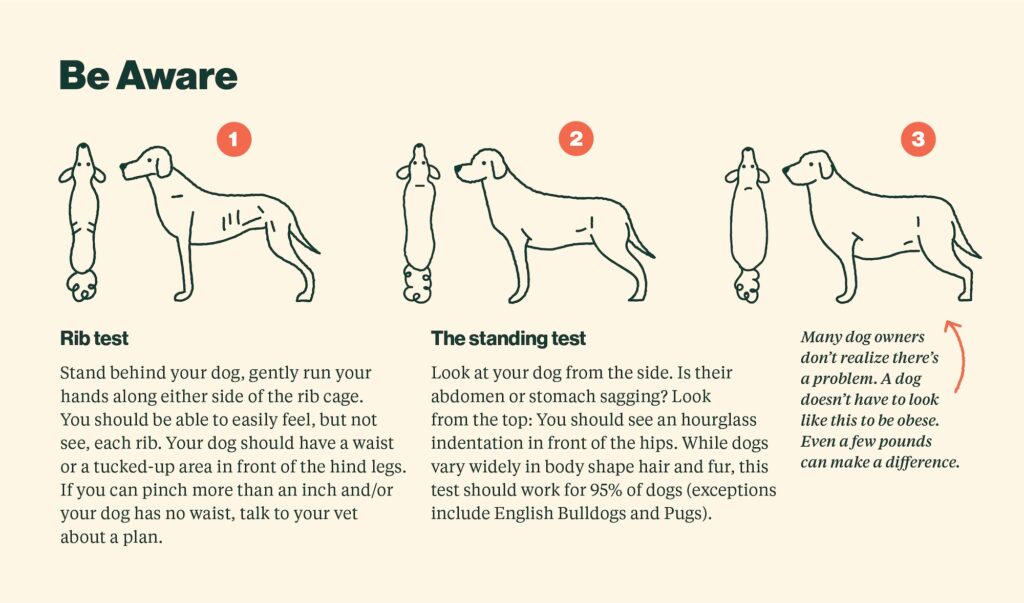
The simplest way to gauge whether your dog is overweight is by testing their body condition.
Veterinarians assess your dog’s body condition by sight and touch, grading it with something called a “body condition score.” Typically using a 9-point scale that ranges from too skinny (1) to obese (9), they will determine whether your dog needs to lose, maintain, or gain weight, aiming for the ideal range of 4 to 5.
Alex Larsen, DVM, a general practice and urgent care veterinarian and small animal veterinary clinical nutrition resident with Whole Pet Provisions and the University of Tennessee College of Veterinary Medicine, explained that a body condition score is useful because weight alone doesn’t tell the whole story—one 20-pound dog could be rail-thin while another could be obese. What weight is considered healthy differs tremendously depending on breed and size. Even within a single breed, healthy weight can vary.
Your dog’s body condition score doesn’t need to reach the top of the scale before you take action—Dr. Larsen said to make a weight-loss plan if your dog has a body condition score of 6 or higher.
You can evaluate your dog’s body condition yourself. Here are three things to look at:
Ribs: Stand behind your dog, or straddle them so you have an overhead view. Look at and feel their ribs, feeling all along their rib cage.
Waist: While you’re still standing behind your dog, take a look at their shape from above. Gently run your hands from their rib cage to their hips. Look for the pelvic bone. Look for and feel their lumbar vertebrae, which are on their lower back.
Belly: Stand or sit beside your dog and look at their shape side-on. Look at the slope of the belly as it meets the hind legs. If your dog has longer hair, you will have to feel for this slope.
For more details, check out our full guide to evaluating your dog’s body condition at home.
How many calories should my dog eat?
A useful tool for determining how many calories your dog should eat is a calorie calculator; you can also use the resting energy requirement (RER) formula, or “the number of calories required to sustain just the process of life if you are sitting still,” said Susan G. Wynn, DVM, Diplomate of the American College of Veterinary Nutrition, one of the on-staff, Board-Certified Veterinary Nutritionists® at The Farmer’s Dog. But your veterinarian is always your best partner in determining an informed diet plan for your dog.
And when you sign up for The Farmer’s Dog, we tailor your dog’s portions to their individual calorie needs—no math necessary on your part.
Having said that, here’s one way to calculate your dog’s RER formula:
- Start with your dog’s weight in pounds. (If you’re using your dog’s weight in kilograms, skip Step 2.)
- Divide that number by 2.2.
- Multiply that number by 30.
- Add 70.
The RER for a 10-pound dog is about 206 calories. But this figure is only a starting point—as you may have noticed, the only variable it accounts for is weight. For a more complete picture, calculate your dog’s maintenance energy requirement (MER). Their MER is the number of calories required to maintain their weight and body condition based on unique factors such as spay/neuter status, life stage, and activity level. However, the MER calculation can only account for one additional factor at a time, such as spay/neuter status or age or activity level.
To find MER, multiply RER by a certain number that accounts for a particular factor, which you can find in this chart from the Merck Veterinary Manual. If that same 10-pound dog is a healthy, obesity-prone adult, multiply their RER (206 calories) by 1.4 (from the Merck Veterinary Manual), making their MER about 288 calories. Read more about energy requirement estimations here and here.
These figures are only approximations. Furthermore, a healthy diet is about more than calories—dogs also must eat food that’s complete and balanced for their nutritional needs. Talk to your veterinarian or a veterinary nutritionist about the best way to feed your dog when it comes to a food’s nutritional composition and daily calories.
What should I feed my dog for weight loss?
Talk to your veterinarian about what to feed your dog for weight loss, and make sure that whatever you choose meets their nutritional needs.
The Farmer’s Dog has advantages that make it a good choice for a dog on a weight-loss plan. Our complete and balanced fresh food comes in pre-portioned packs tailored to your dog’s individual calorie needs. These portions are based on your dog’s weight, age, sex, breed, spay/neuter status, and other factors, making it simpler to feed them exactly as much as they need. Unlike inconsistent portion sizes from kibble scoops, food from The Farmer’s Dog makes weight management easy.
Can I just feed my dog less of their current food to make them lose weight?
Don’t simply feed your dog less of their current diet without veterinary guidance. This can create even more problems.
“The levels of multiple nutrients may fall short of your dog’s requirement, and as often happens, your dog’s hair coat begins to fall apart, look dull, or shed out,” Dr. Wynn said.
A complete and balanced diet for healthy adult dogs is designed to deliver a particular amount and ratio of vitamins and nutrients; feeding your dog less food may deprive them of vital nutrition. It can also leave them overly hungry, potentially spurring them to beg, dig through the trash, and scavenge from other pets’ food, Dr. Larsen said.
Work with your veterinarian to create a proper weight-loss plan that will meet your dog’s nutritional needs.
Should I free-feed my dog?
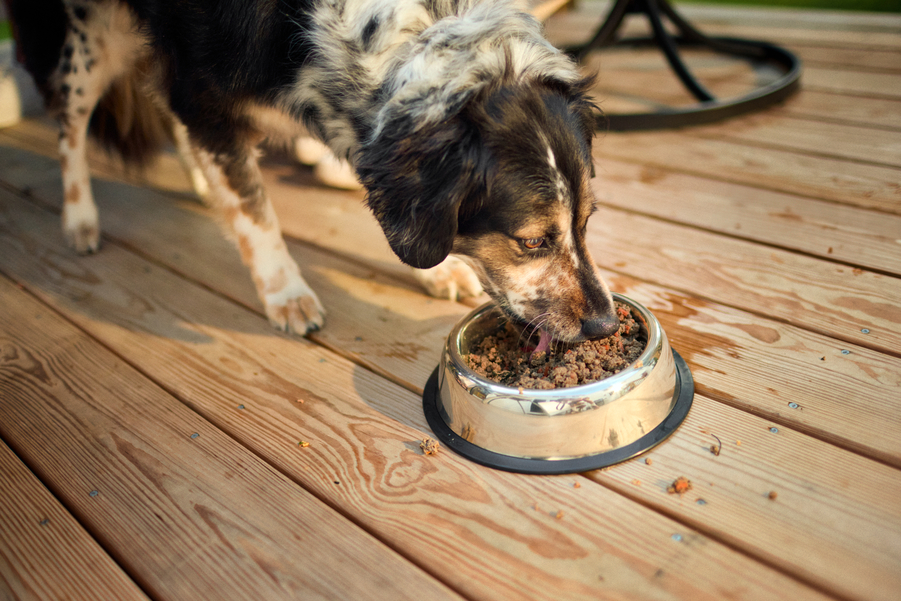
The way you feed your dog matters for weight loss, too. Stick to a schedule, never free-feeding them. Dogs who can graze whenever they feel like it may gain weight. And free feeding also makes it harder to keep track of your dog’s eating habits and notice changes like loss of appetite that can be signs of illness.
How many treats can I give my dog if they need to lose weight?
You don’t need to do away with treats entirely if your dog is on a weight-loss program, but “use them in moderation,” Dr. Larsen said. Follow the 10% rule—make sure treats account for no more than 10% of your dog’s daily calories. This goes for any dog, not just those who need to lose weight.
Treats’ nutritional value also matters. “Avoid high-calorie treats when possible,” Dr. Larsen said. (Cheese and peanut butter are two examples.) “There are many great low-calorie treats, as well as fresh or frozen vegetables and fruits” like blueberries, baby carrots, apples, bananas, green beans, and broccoli. Never feed grapes, raisins, onions, or garlic, which are toxic to dogs; always remove fruit pits, which are choking hazards; and cut them into bite-sized pieces so your dog can enjoy them safely.
Snap Sticks from The Farmer’s Dog break into bite-sized pieces, making portion control easy. We also provide you with personalized serving limits, and daily treat calories are baked into your dog’s calorie plan—so you never need to worry about excess treat calories wrecking your dog’s diet.
What is a safe weight-loss rate for my dog?
Dogs can safely lose 1–2% of their body weight weekly, Dr. Larsen said. Check your dog’s weight every two to four weeks as they lose weight.
The best weight-management strategy is a stepwise plan built on good daily habits practiced consistently every day.
How do I make a safe weight-loss plan for my dog?
Work with your veterinarian to create a clearly outlined plan that has specific, well-defined goals and steps. Here’s one way to proceed:
- Rule out medical causes for your dog’s weight gain. These can include an altered metabolism from conditions like hypothyroidism and Cushing’s disease.
- Determine an estimated ideal weight for your dog with your vet. This figure may change as your dog loses weight.
- Perform a food audit with your vet. Tell them everything about your dog’s current diet: their daily meals, feeding schedule, treats, extras from the table, daily supplements, chews, meal toppers, and anything else that adds calories. “Everything that goes into your dog’s mouth each day matters,” Dr. Larsen said.
- Choose a new diet. Safely limit calories to the degree needed for healthy weight loss while meeting daily nutritional needs and keeping them feeling full. Your vet can give you a daily calorie target and calculate how much food, including treats, to give them. Once you’ve kept your dog at an ideal body condition score for about three months, you’ll know their daily calorie intake is the one that maintains that healthy weight, Dr. Wynn said. Again, if you choose The Farmer’s Dog, we’ll provide you with a meal plan tailored to your dog’s specific calorie needs.
- Track your dog’s weight, checking it every two to four weeks, Dr. Larsen said. Update their diet and daily calories based on their progress.
- Assess your dog’s body condition score with the vet once they reach their target weight to consider whether they need to lose more weight or gain some back. You may also determine a new diet and calorie allotment for weight maintenance.
- Add exercise. Physical activity, Dr. Larsen said, plays a key role in maintaining lean muscle mass, supporting metabolism, and contributing to overall health for dogs.
Increase exercise gradually. If your dog is new to regular exercise, “we don’t want to go to very high activity right off the bat,” he said. Overweight dogs are at higher risk of orthopedic diseases, “so building strength and endurance is an important step to reduce risk of injury.” Veterinary rehabilitation specialists can provide structured training plans and low-intensity options like underwater treadmills.
Why isn’t my dog losing weight on a diet?
Your dog might not be losing weight despite being on a diet for several reasons.
Here are a few common culprits:
- The diet is still too caloric. Especially early in this process, you may need to adjust daily calories. If you’re reducing further, do so with veterinary supervision to confirm your dog is still getting all the essential nutrients.
- There isn’t 100% commitment. For your dog to succeed on a diet, everyone in their life must commit. Just one person offering verboten snacks—like a child feeding from their plate or a well-meaning friend offering treats—can keep them overweight.
- There’s an underlying medical condition. While this is less likely than excess calories, your veterinarian will still want to perform tests to rule out conditions like Cushing’s disease or hypothyroidism, which can cause unwanted weight gain.
- The diet isn’t right for them. If your dog is otherwise healthy and eating within their targeted calorie range, ask your veterinarian or a veterinary nutritionist about trying a food with a different macronutrient profile (meaning different amounts and proportions of nutrients like protein, fat, and carbohydrates). Every dog is an individual, so finding a diet with the right nutritional composition can take some trial and error.
Don’t kick yourself if you have an imperfect day; you can still get back on track.
“Weight loss is almost never going to be simple and smooth,” Dr. Larsen said. “There will be hiccups, and begging puppy dog eyes will win sometimes.” Using your veterinarian as an accountability source can help keep you and your dog on track—and every meal is a chance to recommit to improving your dog’s health.
The post How To Help Your Dog Lose Weight appeared first on The Farmer’s Dog - Digest.
Comments
Post a Comment