In this article:
- How many times a day should I feed my dog?
- How many times a day should I feed my puppy?
- How many times a day should I feed my adult dog?
- How many times a day should I feed my senior dog?
- Is it okay to feed my dog once a day?
- Can I free-feed my dog?
- What happens if I feed my dog too much or too little?
- Does it matter what time I feed my dog?
You likely know how important it is to feed your dog a complete and balanced diet that they enjoy. But how often should they eat? The answer depends on your dog’s individual needs, but experts do offer some general guidelines.
“Generally, for a healthy adult dog, feeding twice daily—roughly in the morning and evening—is recommended,” said Alex Larsen, DVM, a general practice and urgent care veterinarian and small animal veterinary clinical nutrition resident with Whole Pet Provisions and the University of Tennessee College of Veterinary Medicine. But this is not a hard and fast rule. “All dogs are individuals,” he said, “and there is not one schedule or routine that consistently works for all dogs.”
With that in mind, here’s what to consider when deciding on the right feeding frequency for your dog.
How many times a day should I feed my dog?
Depending on your dog’s health needs, you can feed them as few as one meal or even upwards of four smaller meals throughout the day. Their optimal schedule may change as they age.
What’s most important is that you feed your dog proper portions to maintain a healthy weight, and do so on a consistent schedule.
“Dogs are routine-driven animals,” Dr. Larsen said. “Maintaining a day-to-day routine makes dogs feel more secure and comfortable.”
Keeping your dog on a schedule can create a strong foundation that teaches them that food appears at regular hours, and for a limited time. On the other hand, free-feeding accustoms your dog to constantly available food that they can take or leave at their convenience. If your dog ever needs to follow a strict medication regimen and eat with meals, the adjustment may be easier if they’re used to eating on a schedule.
How many times a day should I feed my puppy?
For at least the first eight weeks of their life, your pup should ideally be with their mother, getting their nutrients from her milk. This is their best source of nutrition, and also provides antibodies to help ward off disease. Puppies should be completely weaned—meaning transitioned from milk to solid food—between 6 and 8 weeks.
From weaning to around 6 months, veterinarians usually recommend that puppies be fed three to four times per day. In addition to having different nutritional needs from those of adult dogs, growing puppies have smaller stomachs, but much higher nutrient and calorie needs relative to their body size—so they need smaller, more frequent meals in order to eat enough. Puppies, Dr. Larsen said, “benefit from more consistent absorption of nutrients over the course of each day.”
At 6 months for most breeds, you can start to transition your dog to once- or twice-daily feedings. During this transition, it’s important to keep feeding your dog the same amount of food as before, and try to stick to their schedule as much as possible; when you consolidate meals, each individual meal will get bigger. To help your dog adjust, slowly decrease the amount of food fed during mealtimes you’re phasing out over two or three weeks, adding to the meals that will be part of their new schedule.
How many times a day should I feed my adult dog?
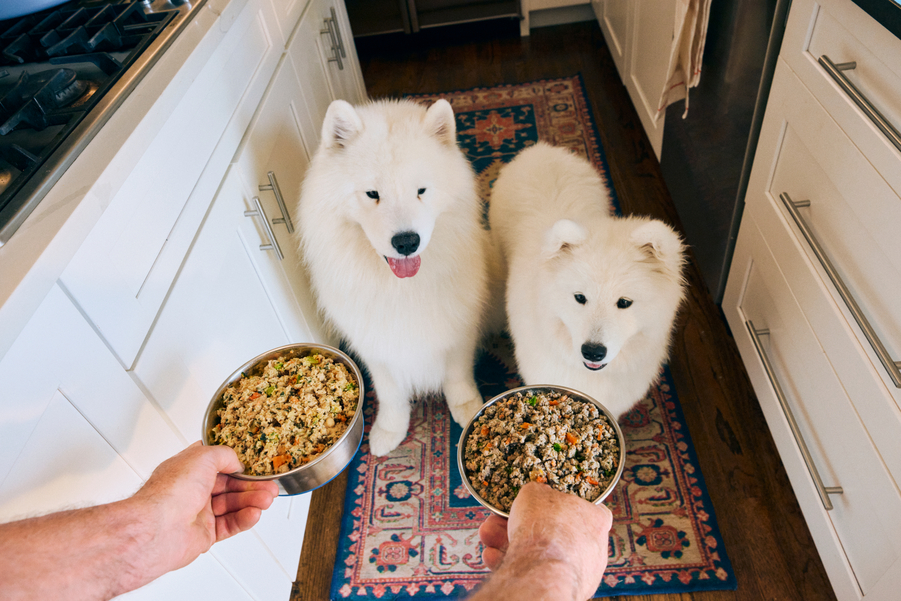
Most healthy adult dogs can eat all of their day’s food in one meal, or have one meal in the morning and one in the evening. The best feeding routine is the one that works for both of you every day.
And not every dog can or should eat once or twice per day; certain health conditions may influence your dog’s feeding schedule. For example, dogs who are prone to gastric dilatation-volvulus (GDV)—a life-threatening medical emergency in which the stomach bloats and flips over—are recommended to eat two or three smaller meals throughout the day to reduce their risk of GDV. Dr. Larsen added that dogs with gastrointestinal conditions, such as gastroesophageal reflux disease (GERD) or impaired digestion, may also benefit from smaller, more frequent meals. The same goes for dogs who experience bilious vomiting. And if a dog receives daily medication that they need to take with food, mealtimes should be scheduled around their regimen.
The Farmer’s Dog comes pre-portioned for your dog’s age, breed, weight, spay/neuter status, and more. As your dog’s needs change we work with you to ensure they get all the vitamins and minerals they need—and offer instructions on how much to feed them.
How many times a day should I feed my senior dog?
The answer to this question varies according to your senior dog’s nutritional needs, activity levels, medical conditions, and other factors. Many senior diets are marketed for dogs aged 7 years and older—but since lifespans vary by breed, the American Animal Hospital Association (AAHA) defines the senior life stage as the last 25% of a dog’s expected lifespan. Regardless, there’s no reason to change what you’re feeding your dog, or how often, simply because they’ve reached a certain age. Instead, you should take into account their individual needs.
To determine how often you should feed your senior dog, pay attention to whether they finish all their food. With a slowing metabolism or less active lifestyle, they may eat less food at once; smaller portions can also help stave off unwanted weight gain. You can try offering smaller meals more frequently, even three or four times a day, if their appetite is diminishing. If more frequent meals don’t encourage your dog to eat, go to the vet to rule out medical reasons. This will help you make sure that your dog continues getting all the nutrients they need.
Is it okay to feed my dog once a day?
Yes—it’s okay to feed most healthy adult dogs once a day. But, as noted above, every dog is different, and you should consult your veterinarian about whether any health conditions or predispositions mean your dog should eat more frequently.
In 2022, a team of researchers published a paper using data from the Dog Aging Project, an initiative that brings together dogs, owners, veterinarians, and researchers to study canine health and longevity. Analyzing information from tens of thousands of dogs, and controlling for sex, age, breed, and other factors, they found that dogs fed once daily rather than more frequently had, on average, lower (meaning better) scores on a cognitive dysfunction scale, and lower odds of various health disorders.
But this was an observational study, which means the authors couldn’t draw conclusions on cause and effect. It also used cross-sectional data, meaning it showed the characteristics of a population in a single moment. It didn’t compare a control group and an experimental group, nor did it follow the group over a period of time to see how they changed. It also included data from various breeds, so average lifespan and healthy weight weren’t uniform.
It’s also possible that dogs who were fed more frequently were already living with health conditions that required them to eat with medication throughout the day. When it comes to cause and effect, “we don’t know which direction the arrow is going in,” said lead author Emily Bray, PhD, an assistant professor at the University of Arizona College of Veterinary Medicine.
Can I free-feed my dog?
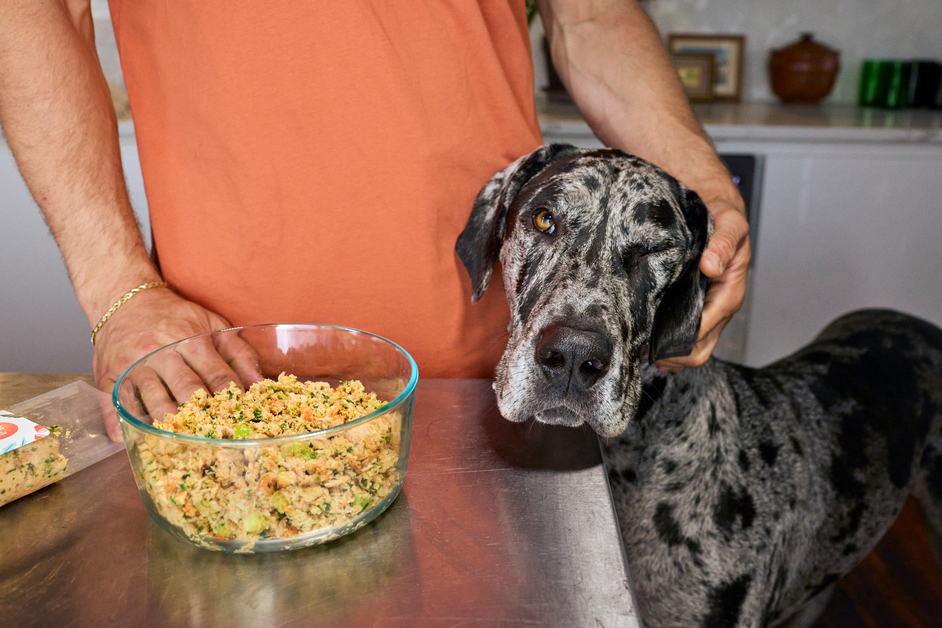
Free-feeding your dog, or leaving their food out throughout the day so they can eat whenever they want, is not a good idea. It increases the risk of overfeeding, makes monitoring their well-being a challenge, and is difficult to manage in a multi-pet household potentially requiring different diets. It’s also risky from a food-safety perspective. (Fresh food from The Farmer’s Dog, for example, should only be out of the refrigerator for two hours at room temperature. More details here.)
“Overfeeding is far easier to do with free-feeding,” Dr. Larsen said. Overfeeding increases your dog’s risk of obesity, which increases their risk of many different health conditions.
With constantly available food, dog owners can’t easily track their dog’s food intake—and changes in appetite can be a key sign of illness. “Monitoring appetite is an important piece of information that can indicate potential health changes,” Dr. Larsen said.
And if you live with multiple pets, free-feeding means they may eat somebody else’s food—putting them at risk of obesity and health complications from eating a food that’s not meant for them. “Free-feeding can [make it] tough to [give] each individual their best diet,” Dr. Larsen said.
What happens if I feed my dog too much or too little?
Feeding your dog too much can increase their risk of obesity, while feeding them too little puts them at risk of malnutrition.
“Feeding too much is one of the most common issues we see in dogs,” Dr. Larsen said. Overweight dogs are far more prone to diseases like osteoarthritis, ligament injuries, diabetes, heart disease, reduced immune function, and more, he said. Research shows that lean dogs can live up to 2.5 years longer than their overweight counterparts.
Feeding too little also presents dangers. Nutrient deficiencies can be hard to spot unless they’re severe, Dr. Larsen said. Some common signs of malnutrition include poor muscle condition and poor hair or skin due to insufficient proteins and amino acids, reduced metabolism, and certain heart diseases.
Feeding less of your dog’s food to achieve weight loss may put them at risk of malnutrition. “If you need to work on weight loss for your pet, discuss a feeding plan with your veterinarian, and closely monitor their weight on a routine schedule,” Dr. Larsen said.
If you feed The Farmer’s Dog, our Customer Care team can help you adjust your plan to fit your dog’s evolving nutritional needs.
Does it matter what time I feed my dog?
As Dr. Larsen said, consistent routine matters more to your dog’s sense of security than the exact timing of their meal or meals. But it’s worth considering how to time their meals with other parts of their day.
For example, you may want to make sure there’s a break between mealtime and walk time depending on how much activity your dog is used to.
You may also want to feed at least two or three hours before your dog’s bedtime so there’s time for them to go to the bathroom before everyone turns in for the night. “Some dogs also get more energetic shortly after eating,” Dr. Larsen said, “which could make settling down to go to sleep tougher.”
If you have any questions about your dog’s feeding schedule and how it may be impacting their health, talk to your veterinarian. And remember that even more important than how frequently you feed your dog is what you feed them; every dog should eat healthy food that’s complete and balanced for their needs.
The post How Often Should You Feed Your Dog? appeared first on The Farmer’s Dog - Digest.
Comments
Post a Comment