In this article:
- What is a dog’s body condition score?
- How do I measure my dog’s body condition?
- How do I know if my dog is in ideal body condition?
- How do I know if my dog is underweight?
- How do I know if my dog is in rounded body condition?
- How do I know if my dog is in overweight body condition?
- When should I start testing my puppy’s body condition?
This article was originally published in January of 2021, and has been updated.
Research shows that lean dogs can live up to 2.5 years longer than their overweight counterparts. But, sadly, most American dogs are overweight or obese—as of 2022, the figure was 59%. And one of the best ways to make sure your dog is in good shape is to check their body condition using the same 1 to 9 scale veterinarians rely on.
While you should always take your dog for regularly scheduled veterinary checkups, you can also test their body condition at home to make sure you’re keeping them on track. Here’s why, and how, to do that.
First of all, what is a dog’s body condition score?
It’s a good idea to monitor your dog’s weight, checking it regularly during vet visits and ensuring that it stays within the healthy parameters for their breed, size, and age. But weight doesn’t tell the whole story; one 20-pound dog might be rail thin, and another might be chunky.
Veterinarians assess your dog’s body condition by sight and touch using something called a “body condition score.” Typically using a 9-point scale that ranges from too-skinny (1) to obese (9), they will determine whether your dog needs to lose, maintain, or gain weight, aiming at the ideal range of 4 to 5. Body condition score is vital information when it comes to determining—and updating—portion sizes.
Testing your dog’s body condition at home doesn’t require a scale, or any equipment—just your hands, eyes, and a few minutes of attention to your dog, which they’ll likely enjoy! Testing body condition this way works for any dog, no matter their size or how much fur they have. For dogs with longer or thicker hair, just be sure to rely on the touch tests—it will likely be harder to see the contours of their bodies.
How do I measure my dog’s body condition?
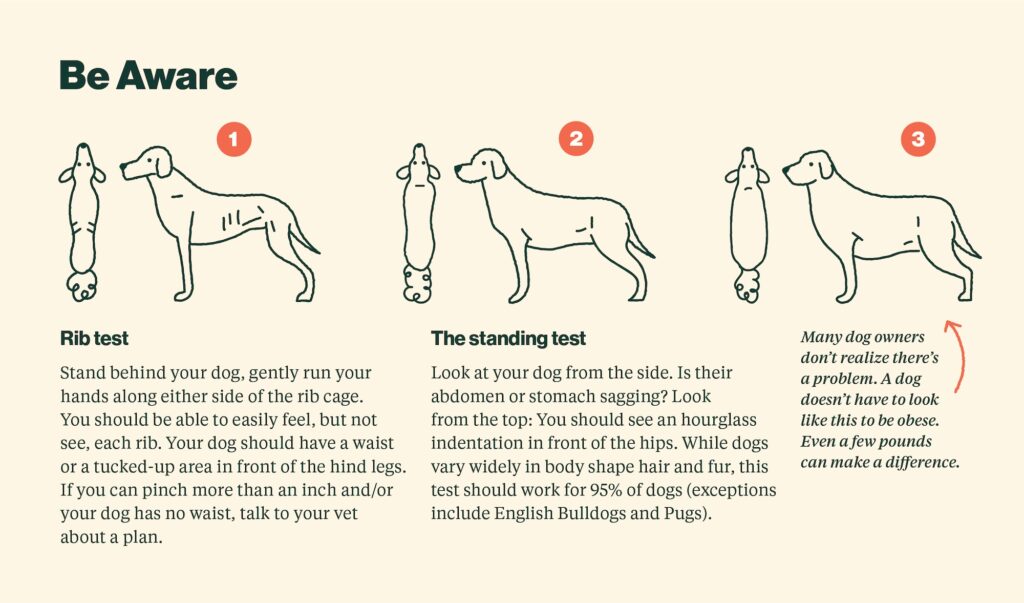
Test the following areas on your dog:
Ribs: Stand behind your dog, or straddle them slightly. Look at and feel their ribs, feeling all along their rib cage.
Waist: While you’re in this position, take a look at your dog’s shape from above. Gently run your hands down your dog’s body from their rib cage to their hips. Look for the pelvic bone. Look for and feel their lumbar vertebrae, which are on their lower back.
Belly: Stand or sit beside your dog and look at their shape side-on. Look at the slope of the belly as it meets the hind legs. If your dog has longer hair, you will have to feel for this slope.
How do I know if my dog is in ideal body condition?
Your dog’s ribs are not clearly visible when you’re standing away from them, looking from the side. In some short-coated dogs, the last few ribs may be visible if you’re standing close.
You’ll be able to easily feel your dog’s ribs with flat fingers and not much pressure. They’ll have just a slight layer of muscle covering them, and shouldn’t feel sharp. Your dog’s waist should have a slight hourglass shape, narrowing in front of their hind legs when looking from above. Their ribs should be a bit wider than their waist.
You’ll also feel a slight hourglass shape as their waist narrows ahead of the hind legs. If your dog has longer hair, you may not be able to see this shape clearly, so be sure to feel this area.
From the side, you’ll see an abdominal tuck. The abdominal area behind their rib cage slopes upward as it meets their hind legs, instead of forming a straight line from front leg to back leg.
If your dog has very long or thick hair, you may not see the abdominal tuck clearly, which is why it’s important to feel this area. You can also look for the abdominal tuck when your dog is wet.
How do I know if my dog is in underweight body condition?
If all or most ribs are clearly visible when you’re standing away from your dog, that indicates an underweight body condition. Note that if your dog has long or thick hair, ribs may not be as visible—but they can still be underweight, so it’s important to feel for them.
If you don’t feel a thin layer of fat over the ribs, your dog is too skinny.
Underweight dogs will likely have an exaggerated waistline. Their hip bones and spine are visible, and the dog’s body will tend to have a “bony” feel.
How do I know if my dog is in rounded body condition?
In dogs with a rounded body condition, their shape will appear straight from their rib cage to their hips. They may have a slight abdominal tuck, but possibly no tuck at all.
They may have a visible waistline, but it won’t be prominent. Their ribs can be felt, but they’ll have a heavier layer of fat covering them. It’s possible that you’ll only be able to feel them with significant pressure.
How do I know if my dog is in overweight body condition?
Dogs who are overweight will likely look barrel-shaped when viewed from above. Their ribs will be under a thick layer of fat, and you may not be able to feel them at all.
Their waistline will not be visible. They may be rounded when you feel their midsection. Pads of fat can be felt on their back, neck, and the base of their tail.
In overweight dogs, there is no visible abdominal tuck when viewing the dog from the side, and their belly will sag downwards.
When should I start testing my puppy’s body condition?
Before 4 months old, your puppy may not have a defined waist. They may also have a rounder belly and other marks of a healthy, fast-growing pup. A healthy puppy should gain weight every day.
After four months, you can begin keeping track of their body condition using the same methods outlined above.
Different dog breeds vary widely in body shape and volume of hair and fur, but these tests work for nearly all breeds. If you have questions about what your dog’s ideal body looks like, talk to your veterinarian.
And consider signing up for a pre-portioned fresh food plan as part of a program to help keep your dog in ideal body condition.
The post How To Measure Your Dog’s Body Condition appeared first on The Farmer’s Dog - Digest.
Comments
Post a Comment