In this article:
- Why letting your child ride your dog is dangerous for your dog
- Why letting your child ride your dog is dangerous for your child
- How to teach your child not to ride your dog
- Safe ways for kids and dogs to play together
If you have a small child and a large dog in your life, it’s possible the child half of that pair has shown an interest in riding the dog like a horse. As funny as the image might seem in your mind, we regret to inform you that it’s a bad idea to let it happen.
Yes, some large-breed dogs weigh 150 pounds or more, far exceeding the weight of a toddler or infant. But, despite their relatively sturdy frames, big dogs are not physically or psychologically suited to turn your living room into Churchill Downs.
Here’s why, along with tips on teaching your child to respect your dog’s boundaries—and some safer ideas for kid-dog fun.
Why letting your child ride your dog is dangerous for your dog
One simple but important reason not to let your child ride your dog is that, at minimum, your dog will almost certainly find the experience unpleasant.
“It’s absolutely not comfortable for dogs to have a child sitting on them, no matter their size,” said Jennifer Shryock, a certified dog behavior consultant and owner of North Carolina–based Family Paws, an organization that helps families navigate raising dogs and babies.
No matter how large the dog or how small the child, dogs aren’t built for carrying others on their backs. People have bred dogs for many purposes, but not that one.
“There’s never been a line of dogs for carrying people or other animals,” said Kathleen Ham, DVM, Diplomate of the American College of Veterinary Surgery (Small Animal), a clinical associate professor of soft tissue surgery and minimally invasive surgery at the University of Florida College of Veterinary Medicine. Even dog lineages selected for rescue were never meant to bear the full weight of another creature riding around on their backs.
Especially in dogs with orthopedic issues like hip dysplasia, excess pressure from a child sitting on their back can cause pain. It puts pressure on the dog’s spine, legs, and hips, potentially exacerbating any pain or soreness the dog may already be feeling.
A dog might appear to tolerate a child sitting on them, but could still be sending distress signals that are easy for people—particularly children—to miss. “People think it’s okay if the dog doesn’t ‘complain,’” Shryock said, “but in actuality the dog is communicating with subtle body language that they’re not happy.”
A lack of protestation doesn’t mean a dog is okay with becoming a high chair. “Sometimes big dogs have the gentlest dispositions, and they may not object,” said Lori Evans, PhD, a psychologist in New York, “but that doesn’t mean it’s the right thing to do.” Quieter signs of disapproval include whale eye, licking lips, turning away, and yawning. Subjecting a dog to stressful situations is not only disagreeable for them, but in some cases may also lead to aggression that endangers dog and child alike.
Why letting your child ride your dog is dangerous for your child
As noted above, a human being sitting on a dog is stressful for the dog, and stress can lead dogs to lash out to protect themselves—including by biting.
Even “the nicest dog in the world may respond in a manner that could be very dangerous for a child,” said Ally Sterman, DVM, Diplomate of the American College of Veterinary Surgery (Small Animal), a clinical assistant professor of small animal surgery at the Ohio State University.
As mentioned previously, a dog who’s mistaken for a rocking horse may communicate fear, anxiety, and discomfort through subtle signs that children haven’t learned to identify. If the child persists in forcing them to play rodeo despite those signs, the dog may feel they have no choice but to growl or snap. “When dogs’ body language is ignored, it doesn’t end well,” Shryock said.
Even if playtime between a child and dog starts off copacetic, roughhousing creates more opportunities for miscommunication. If a child is riding on a dog’s back, not paying attention to the position of their ears or movements of their head, the situation could deteriorate quickly.
Children are the most likely victims of dog bites in the US, according to the American Veterinary Medical Association. And, in addition to injuring children, bites can lead to consequences as severe as dogs being rehomed or even euthanized.
This is one of many reasons to always supervise dogs and children when they’re together. Shryock puts it this way: “Dog and baby on the scene, a parent in between.”
Apart from the risks of bites, children attempting to ride dogs could also get hurt by falling off of the dog or colliding with furniture.
And the drawbacks of trying to ride a dog extend beyond the immediate term. For dogs, “every interaction is either strengthening or weakening the bond with the child,” Shryock said. “We want to be constantly focusing on things that build trust.” Letting your child attempt to ride your dog could weaken that trust, leading the dog to build negative associations with the kid.
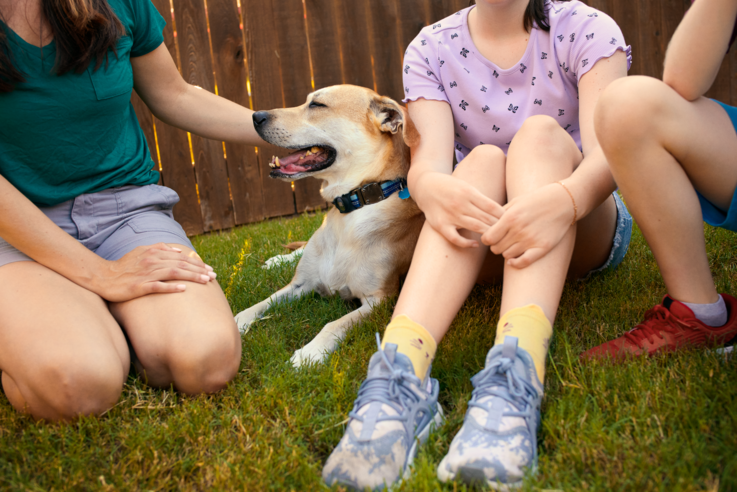
Shryock’s guidance to “sit on the ground, not the hound” (she likes the instructive couplets!) applies to sitting on dogs in any capacity, be it leaning on them or using them as a pillow. None of these behaviors are ideal for the dog-child relationship.
How to teach your child not to ride your dog
If your kid keeps recruiting their Saint Bernard to play bucking bronco, there are ways to gently correct the behavior.
Rewarding the absence of the behavior is one way to use positive reinforcement with your child, Dr. Evans said—like by letting the child play with the dog and give them treats as long as they are respectful and gentle with them.
On the other hand, enforcing a 10-minute timeout if a kid keeps treating the dog inappropriately could send a message that the dog needs to be treated as a fellow creature with needs and feelings.
Shryock recommended invoking empathy by asking children how they feel when they’re crowded or when somebody is in their space, and whether they like it.
And keep an eye on your kid and dog whenever they’re together. Dogs should always have the choice to be alone, whether that’s in a crate, bed, or room. Supervising your child and dog when they’re together can also ensure that your kid isn’t bothering your dog during their downtime.
Safe ways for kids and dogs to play together
Teaching kids the best way to bond with dogs goes a long way, Shryock said. Telling them to extend an invitation for interaction that the dog then chooses to accept or decline can make everyone safer and happier.
She suggested a model for respectfully petting the dog called the “pet-pet-pause.” In this consent test, the child invites the dog to be petted while allowing the dog the option to ask for more or walk away. If they move toward the child or extend a paw asking for more, then they can continue petting. But if your dog looks away or walks somewhere else, they’re not in the mood.
When you talk to your child, emphasize that dogs deserve consideration and compassion—just like people. “Show that the dog is a member of the family, and we treat all members of the family with respect,” Dr. Evans said. “Dogs are not meant to be ponies.”
The post Why It’s Dangerous To Let Kids Ride Dogs—Even Big Dogs appeared first on The Farmer’s Dog - Digest.
Comments
Post a Comment