In this article:
- Which nutrients do dogs need for healthy growth?
- Is The Farmer’s Dog complete and balanced for puppies?
- When can puppies start eating The Farmer’s Dog?
- Can The Farmer’s Dog help with weight management?
- Do large- and small-breed puppies grow at different paces?
- Are all recipes from The Farmer’s Dog suitable for puppies?
- Do dogs need kibble to clean their teeth?
- Does The Farmer’s Dog offer treats for training puppies?
- We’re here for every step of your puppy journey
This article was originally published in August 2024, and has been updated.
Puppies require complete and balanced food that supports their growth and long-term well-being. The Farmer’s Dog makes it easy to get your new best friend off to a great start and help them thrive throughout their life. Here’s everything you need to know about how The Farmer’s Dog can help keep your puppy happy and healthy.
Dogs need specific nutrients for healthy growth
Puppies have particular nutritional requirements, and not all dog foods meet them. Our recipes are formulated by board-certified nutritionists to be complete and balanced for growing puppies.
At this crucial stage—when your puppy’s bones, brain, and other organs are developing—feeding proper portions of fresh, balanced food is the best way to give them a healthy start. Puppies thrive when they get the ideal mix of vitamins, minerals, and healthy fats. Too much or too little of certain nutrients—like calcium, phosphorus, and vitamin D—can cause health issues. And research shows that a type of omega-3 fatty acid called DHA (docosahexaenoic acid) can improve puppies’ memory and learning. Our fresh food contains human-grade salmon oil to provide this important nutrient.
The Farmer’s Dog is complete and balanced for puppies
The Association of American Feed Control Officials (AAFCO), which sets guidelines for pet food, has requirements for which nutrients—and how much of them—need to be in foods for “adult maintenance” and “growth and reproduction” (the category that includes puppies). The Farmer’s Dog meets all of these guidelines, making it a perfect choice for puppies.
Our recipes contain all the vitamins and minerals that puppy foods are required to have—nothing is missing. This means you can feel secure that your puppy will get all the nutrients they need when they eat The Farmer’s Dog—even if you switch them from a food that’s labeled as a “puppy formula.”
For many years, kibble and canned food were the only commercially available options to feed dogs. But it’s finally possible to do better. While many kibble products may be complete and balanced, most of them are made with feed-grade ingredients and are heavily processed at high heat. Our fresh, gently cooked food is complete and balanced to provide all the nutrients your pup needs, and it’s clinically proven to be highly digestible so dogs can easily absorb its nutrients. This gives your pup a healthy start and helps nourish them throughout their life.

Puppies can start eating The Farmer’s Dog from an early age
Fresh food from The Farmer’s Dog meets the needs of growing puppies—and you can begin feeding them this healthy, balanced food as soon as they’re weaning. Puppies can be offered “gruel” to stimulate food intake starting at 3–4 weeks of age. You can make this gruel by mixing fresh food with a tablespoon or two of warm water. Puppies are typically fully weaned and eating solid food by 7–8 weeks of age.
If your puppy is already on another solid food, transition them to The Farmer’s Dog gradually—this will give their digestive system a chance to adjust. (This isn’t special advice that applies only to our food; it’s generally a good practice to transition a dog’s food slowly.)
The Farmer’s Dog makes weight management easy
One of the most important things you can do to keep your dog healthy in the long run is help them achieve and maintain an ideal body condition. In fact, studies show that lean dogs can live up to 2.5 years longer than their overweight counterparts. Unfortunately, nearly six in 10 American pet dogs are overweight. One reason is that it’s challenging to know exactly how much to feed your dog—most kibble serving suggestions estimate how many “cups” or “scoops” a dog should get based on a broad weight range.
Because The Farmer’s Dog comes pre-portioned for your dog’s individual needs, there’s no guesswork. You’ll know that you’re feeding them exactly as much as they need. It will say right on the label how much to feed your pup each day—all you have to do is follow the directions. Just keep in mind that you’re dividing those portions over a whole day of eating. So if your puppy is supposed to eat one pack every day, but they’re getting four meals each day, you should be feeding them 1/4 of a pack per meal. Avoid overfeeding or underfeeding. If you have any questions, you can always call or email our customer service team.
Though they grow at different rates depending on their breed, all puppies will grow and change rapidly over their first 12 months. And as your puppy grows and changes, we check in regularly to make sure they’re getting the right number of calories. Whether a dog is already at a healthy weight, needs to lose weight, or should put on a few pounds, precise portioning is key to helping them get and stay in shape.
It’s easy to adjust your dog’s plan—and you won’t have to transition them from “puppy” food to “adult” food, because our recipes also meet the nutritional needs of adult dogs (including seniors). Our 24/7 customer service also means that, if you have any questions (like “What do I do if I’m following the instructions, but my puppy still seems hungry?”), someone will be on hand to ensure that your dog is getting the right amount of the right recipe.
For much more detail on how to measure your dog’s body condition, read our guide to the subject.
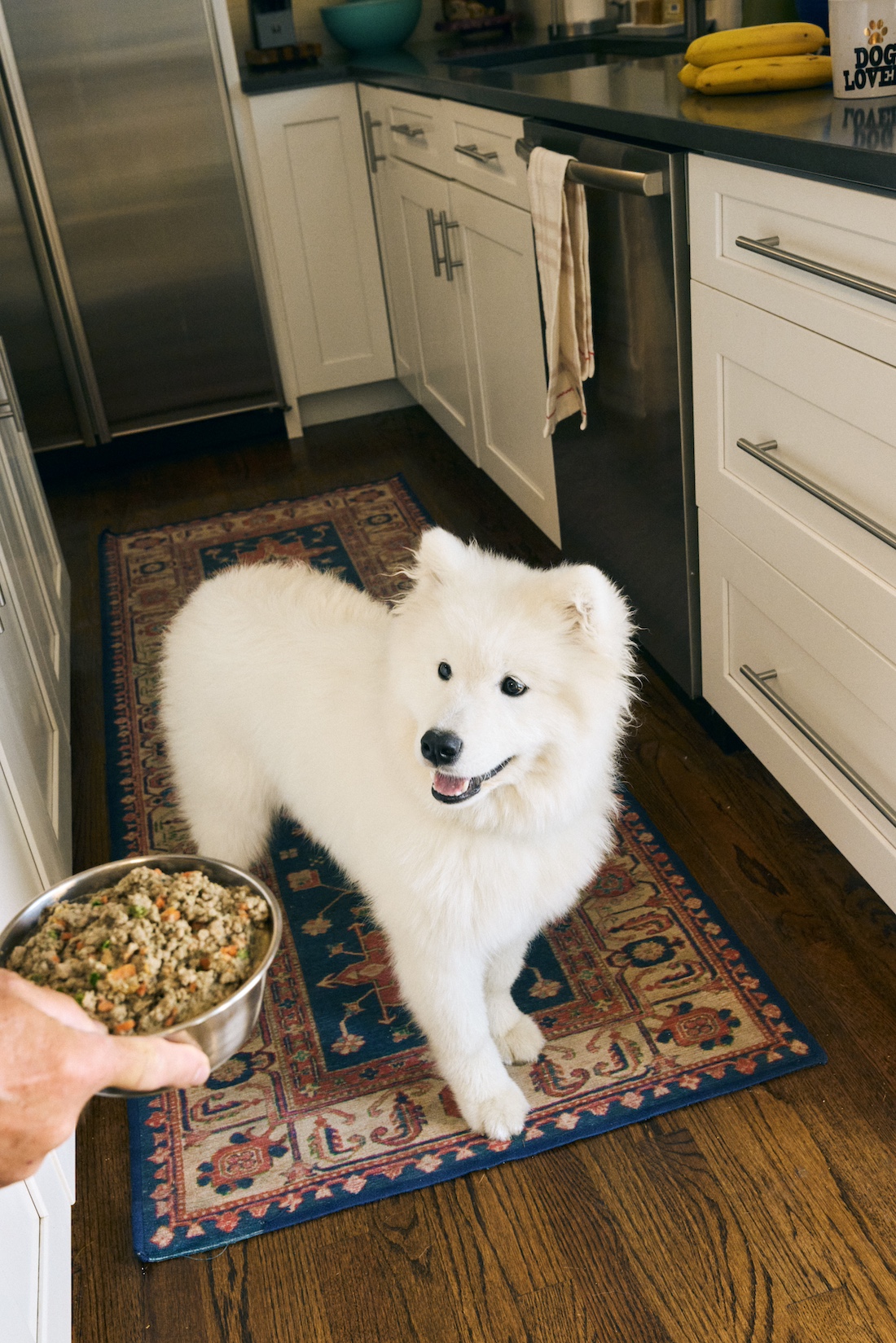
Large- and small-breed puppies grow at different paces
The main thing to keep in mind when feeding a large-breed puppy—one who is expected to be at least 70 pounds when they reach their full size—is that they typically take longer to grow.
Medium-large dogs can take about 12 to 18 months to reach adulthood, and giant breeds like Great Danes may not stop growing until they’re two years old. Larger dogs must grow at a healthy rate—growing too fast can cause orthopedic diseases and obesity. Puppies do not practice portion control, so free-feeding or ad-lib feeding is not advisable. Free-feeding can also make it hard to know when your puppy isn’t feeling well and skips a meal, which can be an early sign of illness. Stick to the daily portions recommended in your plan (in consultation with your vet), and divide those into at least two meals throughout the day.
And, though your large-breed puppy needs vitamins and minerals to grow big and strong, don’t give in to the temptation to add supplements. Their complete and balanced food has everything they require to grow—and, as mentioned earlier, giving them too much of certain nutrients can cause serious health issues.
Small-breed dogs are those who will be 30 pounds and under when fully grown; tiny breeds are those who will remain 10 pounds and under when fully grown. These dogs reach skeletal maturity faster, between about nine and 12 months. Keep in mind that these weight ranges are approximate, and sources may differ about them. The main takeaway is that dogs reach maturity at different paces depending on their breed and expected adult weight.
From about six weeks to six months, it’s usually recommended that puppies be fed three to four times per day. From then on, you can switch them to a twice-daily feeding schedule if you’d like. You may switch large-breed puppies to two meals per day sooner—and some adult dogs do well on one meal per day. If your dog is active, or is always clamoring for food between meals, you can consider switching back to feeding their allotted food in three or four smaller daily meals. Every dog is different, so talk to your vet about what meal frequency makes the most sense for your pup.
Young, small-breed puppies who are less than six months old can be prone to hypoglycemia (low blood sugar), which is one reason that they may benefit from more frequent, smaller meals throughout the day.
“[Before The Farmer’s Dog, mealtimes were] always a struggle, and I usually would end up spoon-feeding her to eat a partial meal. Now, Allie is right there ready to eat when her bowl reaches the floor. I have also noticed her attitude and energy level are much better.”
–Allie’s person
All of our recipes are suitable for puppies
Puppies can eat the same complete and balanced recipe for every meal and thrive all the way through their golden years. But, if your puppy likes to experience different tastes, all recipes from The Farmer’s Dog provide the nutrients they need for healthy growth—so feel free to let them try chicken, beef, pork, and turkey. Some dogs do well rotating foods, whereas others with sensitive stomachs may not, so it’s a good idea to introduce new recipes to your puppy gradually and see how much they like them and how well they tolerate them.
Furthermore, third-party research shows that our food is highly palatable (meaning that dogs love to eat it). This is important for dogs of any age, including growing puppies.
Regular dental care is necessary—but kibble isn’t
There’s a persistent misperception that dogs must eat kibble to keep their teeth clean. In fact, kibble is a highly processed food, and most varieties are not shown to clean teeth. In reality, a healthy diet, daily toothbrushing, and regular veterinary exams are the keys to keeping your pup’s mouth healthy. For more, read our guide to canine dental care.
Our treats are ideal for training puppies
Treats are essential for dog training, and Snap Sticks—which are only available to our subscribers—are perfect for puppies. They taste great, so they make excellent motivational tools for pups. And, because they’re made to be broken into tiny pieces, you can reward your pal frequently without overfeeding them; remember, no more than 10% of your dog’s calories should come from treats or other extras.
We’re here for every step of your puppy journey
Feeding your puppy is an important part of taking care of them, but we know it’s not the only part. And we’re here to support you with insights about training and veterinary care. Here are some puppy-related Digest articles you might find useful:
Bringing a Puppy Home? Here’s What to Do First.
10 Tips for a Happy, Healthy Puppy
Puppy Guide: Health and Veterinary Care
How to Potty Train Your Puppy
Reality (About) Bites: How To Teach Your Puppy Good Mouth Manners
For many more articles on dog care for puppies and adults, check out our full Digest digital magazine. And don’t hesitate to reach out to our customer-care team with any questions; they’re available around the clock to help you and your puppy.
The post Why The Farmer’s Dog Is Great for Your Puppy appeared first on The Farmer’s Dog - Digest.
Comments
Post a Comment