In this article:
- How do I make sure my puppy’s food is healthy?
- How can I keep my puppy in good shape?
- How should I choose a veterinarian for my puppy?
- How often should puppies go to the vet?
- What will happen at my puppy’s first vet visit?
- What vaccine schedule should I follow for my puppy?
- When should I spay or neuter my puppy?
- How can I protect my puppy from parasites?
- How can I provide teething relief for my puppy?
- Should I brush my puppy’s teeth?
- How can I puppy-proof my home?
- How should I socialize and train my puppy?
- How should I pay for my puppy’s veterinary care?
This article was originally published in July 2020, and has been updated.
Nothing brings more pure energy into a home than a new puppy. That energy is delightful, of course, but can also be also overwhelming—not only because nighttime bathroom breaks interrupt your sleep schedule and no object is safe from their teething mouth, but also because this bouncy, bumbling bundle of joy relies on you for… everything, including making sure they get the veterinary care they need.
It’s an awesome responsibility, but a sturdy foundation of health and safety knowledge can help you fulfill it.
Here’s what to know about picking a vet, scheduling appointments, vaccines, proper nutrition, and more ways to keep your new best friend safe and healthy in puppyhood and beyond.
Puppies need healthy food that’s complete and balanced for growth.
Healthy food is essential for a puppy. As their bodies develop, high-quality nutrition is key to fueling their growth. Proper portions of complete and balanced food are also vital to preventing obesity, which is linked to conditions like osteoarthritis, diabetes, heart disease, and cancer.
The Farmer’s Dog offers recipes meeting the nutritional requirements set by the Association of American Feed Control Officials (AAFCO) for adult maintenance and growth and reproduction, which includes puppies. Food that meets the growth and reproduction nutrient profile has proper ratios of all the vitamins and minerals puppies need to grow.
Puppies also require more frequent feedings until they get bigger and can better maintain their blood sugar, according to Alex Schechter, DVM, a veterinarian and founder of Burrwood Veterinary in Michigan. “I recommend feeding puppies three to four times daily until approximately 6 months of age, after which they can be transitioned to a twice-daily feeding schedule,” Dr. Schechter said.
Puppies should grow at the right pace.
Weight management is important, and it starts in puppyhood. A healthy puppy should gain weight every day—but make sure it’s at a pace your veterinarian says is healthy, as overfeeding may lead to weight gain in the form of excess fat rather than muscular and skeletal growth. A rotund pup may be an endearing sight—but, after a certain age, that pudginess could be a sign of obesity.
Our pre-portioned food makes feeding your puppy the right amount easy, allowing them to hit growth milestones without becoming overweight. As they grow, it’s straightforward to update these portions at any time according to your pup’s needs. Talk to your vet about the best diet for your puppy, as they’ll want to know you’re feeding an appropriate complete and balanced food.
Before the age of 4 months, your puppy may have a rounder belly without a defined waist, which is healthy in a fast-growing pup.After four months, you can begin keeping track of their body condition score using a simple test: You should easily be able to feel your pup’s ribs, but not see them. Another on-sight indicator is that most dog breeds should have an hourglass shape that tapers at the waist when viewed from above. If the shape is more like a rectangle, they are overweight. Dogs’ shapes and amounts of fur vary widely, but these techniques will work for almost all of them. Talk to your veterinarian about how best to track your own puppy’s body condition as they grow.
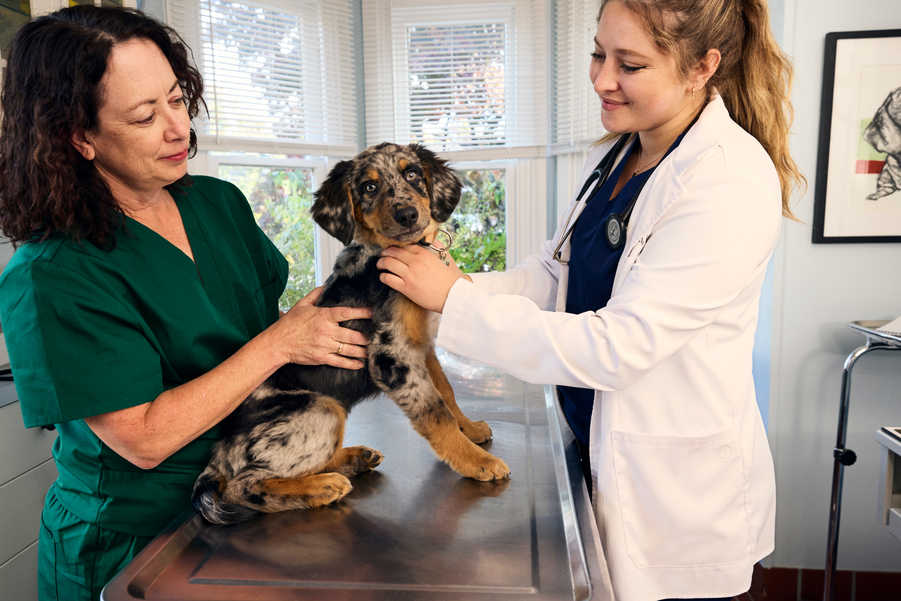
The veterinarian: Your puppy’s primary healthcare provider
Your dog’s veterinarian will be a crucial partner in keeping your dog healthy throughout their life. Here’s what you need to know about this important relationship.
Start looking for a veterinarian as soon as you can. Ideally, you’ll have one picked out before bringing home your puppy—especially because we’re currently in the midst of a vet shortage. No matter when you begin your search, there are plenty of resources available to help you weigh your options. One good place to check is the American Animal Hospital Association (AAHA), a veterinary accrediting organization. Otherwise, you can get valuable input from friends and family; the rescue organization, breeder, or foster parents who had your dog before; and any other trusted dog people in your life.
How often do puppies need to see the vet?
Veterinarians recommend setting up your puppy’s first appointment within a week of adoption. After that initial visit, “depending on when we first see the puppy, we generally recommend three exams by 16 weeks of age,” said Susan Jeffrey, DVM, an associate veterinarian at Odyssey Veterinary Care in Fitchburg, Wisconsin.
Owners can expect to go to the vet every three to four weeks until the puppy is about 6 months old and their vaccine series is complete. That may seem like a lot of vet trips, but “these frequent visits allow the veterinary team to monitor growth, prevent disease, and address developmental concerns early,” said Zenithson Ng, DVM, Diplomate of the American Board of Veterinary Practitioners (Canine/Feline), a clinical professor of small animal primary care at the University of Tennessee College of Veterinary Medicine.
What to expect at your puppy’s first vet visit
In addition to performing a full physical examination, the veterinarian will discuss a wide range of topics related to your puppy’s care. These may include:
- Vaccine protocols
- Emergency planning
- Deworming
- Flea, tick, and heartworm prevention
- Puppy training classes
- Nutrition
- Exercise
- House-training
- Spay/neuter options and timing
- Microchipping
- Integrating your new puppy into a home with other pets
- Pet insurance and other ways to budget for vet care
Questions to ask the veterinarian during your puppy’s first visit
Bring a list of questions for your vet. These might include:
- What do I need to know in case my puppy has an emergency?
- How much exercise should my puppy get?
- When should I start my puppy in training classes?
- How important is socialization, and how do I start the process before my puppy’s vaccinations are all done?
- What do you think about dog parks?
- Do I have to brush my dog’s teeth?
- Should I crate my dog?
- When should I spay/neuter?
Prepare your puppy for their first veterinary visit.
Trips to the veterinarian can be stressful for both dogs and humans, but you can take steps to make the experience more manageable.
Jennifer Merlo, DVM, Vice President of Veterinary Affairs at Fear Free, an organization dedicated to educating the public about reducing patients’ stress at the vet and fostering stronger human-animal bonds, recommended creating positive associations by bringing your pup to the vet for “happy visits.” (The Farmer’s Dog has a partnership with Fear Free.)
“[Happy] visits are centered around exposing the puppy to the sights, sounds, smells, touches, and people they will encounter in the veterinary hospital” or clinic, Dr. Merlo said. They shouldn’t last longer than five minutes, and should consist of solely sniffing around the lobby, receiving treats, and hearing praise from the staff—no medical procedures or exams. Call the vet’s office before dropping by to make sure the scene is calm and the staff are ready to happily receive your pup.
If your puppy is nervous in the car, Dr. Jeffrey suggested starting with very short rides around the block, then increasing the length of time.
Your puppy may show that they are fearful, anxious, or stressed at the vet’s office through signs like hiding behind you, trembling, yawning, whining, averting their gaze, or even aggressive behaviors like biting or growling. Pay attention to these signs, and talk with your veterinarian about ways to lower your puppy’s stress level. You can advocate for them by asking that only tasks that are absolutely necessary be performed that day, Dr. Merlo added. To help your puppy get through these necessary tasks or the next visit, you can bring toys and treats to help build a positive association with the vet’s office. Before their next appointment, consider bringing your puppy for happy visits.
Practice good etiquette at the clinic.
Dogs should be on leashes or in carriers at the vet. This is not merely a matter of courtesy, but is for dogs’ health and safety. “Each clinic has a different setup for waiting patients, but puppies should be kept away from sick dogs, since they are not fully vaccinated,” said Liz Stelow, DVM, Diplomate of the American College of Veterinary Behaviorists, chief of clinical behavior service at the University of California, Davis School of Veterinary Medicine.
Avoid retractable leashes. “They are dangerous, do not allow you control over your puppy, and can give the person using them terrible rope burn,” said Dr. Jeffrey. “Otherwise, keep your puppy on a leash and close to you. Don’t allow them to go sniffing or interacting with the other pets in the waiting room, because some dogs may be aggressive. You may offer the puppy treats when they are behaving.”may be aggressive. You may offer the puppy treats when it is behaving as it should.”
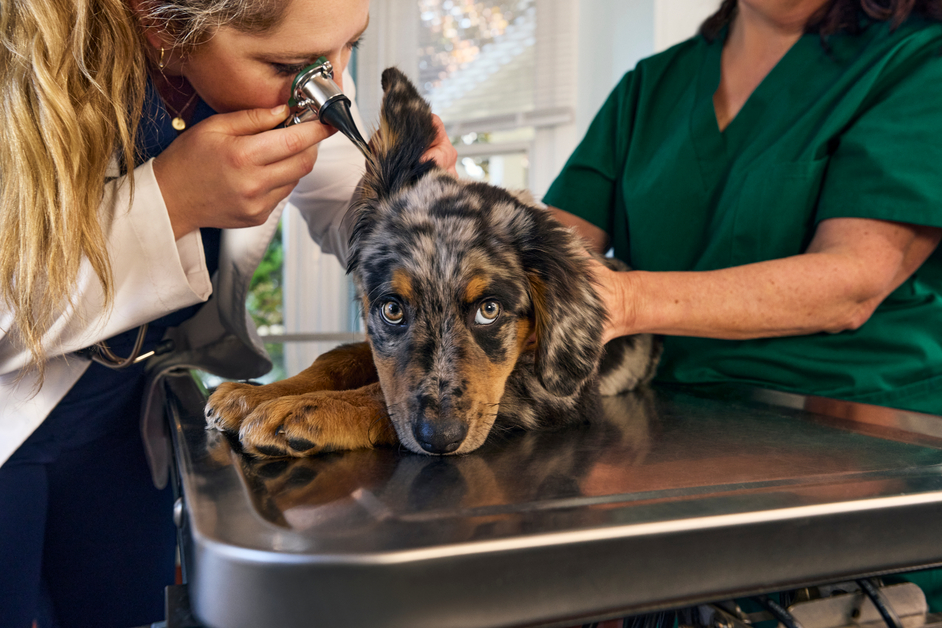
What vaccination schedule should I follow for my puppy?
Vaccines are a vital part of preventative care for puppies. “Because a puppy’s immune system is still developing, infectious diseases are among the greatest health risks during early life,” Dr. Ng said.
The AAHA splits vaccines into two categories: core and noncore. Core vaccines are recommended for all dogs unless there’s a medical reason not to vaccinate, while the need for noncore vaccines varies based on lifestyle factors like where the dog lives and their risk of exposure. Puppies should receive their vaccines between 8 and 16 weeks, plus some boosters after that. With this schedule in mind, your puppy will be making quite a few vet visits in the first few months of their life.
“Your puppy will be at the vet every three to four weeks for vaccine boosters until they are 16 weeks old, or about 4 months,” said Dr. Schechter. “The vaccination schedule may be extended or adjusted based on your puppy’s size or if additional, lifestyle-specific, noncore vaccines are recommended.”
Here’s a breakdown of common vaccines for puppies:
8 weeks
Core vaccines
- Distemper/adenovirus/parainfluenza/parvovirus: Also known as DAPPv, this core vaccine often comes in two or three doses administered two to four weeks apart.
- Distemper is a severe, contagious disease without a cure. The virus that causes distemper attacks the respiratory, gastrointestinal, and nervous systems.
- Adenovirus, particularly adenovirus CAV-1, can cause infectious hepatitis or liver disease in dogs.
- Parainfluenza is a contagious respiratory virus that can cause infectious tracheobronchitis, or kennel cough.
- Parvovirus, or parvo, poses a high risk to unvaccinated puppies less than four months old. It attacks the GI system and is incurable.
16 weeks
Core vaccines
- Leptospira: This vaccine is delivered in two doses, two to four weeks apart after a puppy reaches 12 weeks of age. Leptospirosis, or lepto, is a disease caused by the Leptospira bacteria, potentially causing kidney and liver failure and death.
- Rabies: This devastating disease is entirely preventable with a vaccine required by law in most states. Your puppy should receive their first rabies shot at 16 weeks, a booster one year later, and then boosters again between every one and four years.
Noncore vaccines
- Bordetella: This bacteria causes kennel cough. Its vaccine can be delivered starting at 16 weeks of age.
- Lyme disease: This vaccine can help prevent dogs from getting Lyme disease, carried by ticks.
- Canine influenza: This vaccine protects against two influenza viruses that cause illness in dogs.
After 16 weeks, or when all their vaccines are through, said Dr. Schechter, most pups don’t have to return until it’s time for their annual checkup or spay/neuter procedure. Of course, your vet will offer specific guidance on your puppy’s individual needs.
Spay and neuter considerations
Spay is the surgical removal of a female dog’s ovaries, uterus, and fallopian tubes, which makes her unable to reproduce and eliminates breeding behaviors and heat cycles. Neuter refers to the surgical removal of a male’s testes, which renders him unable to reproduce and reduces behaviors related to breeding.
“Deciding when to spay or neuter a dog is a nuanced and individualized decision that should be made in consultation with a veterinarian,” said Dr. Ng, emphasizing that there’s no “one-size-fits-all” approach to this decision. Your dog’s age, breed, health status, and lifestyle should inform this choice.
But “responsible pet ownership is essential,” he added. “Owners should ensure they are not contributing unplanned litters.”
According to the AAHA, generally accepted guidelines are that small dogs (under 45 pounds expected adult body weight) are spayed or neutered at 6 to 8 months of age, and large-breed dogs (over 45 pounds expected adult body weight) are spayed or neutered after growth stops, between 12 and 15 months. But be sure to consult with your veterinarian on what’s best for your particular puppy.
Other considerations for when to spay or neuter your puppy include cancer prevention and healthy growth, according to Jenna Waltzek, DVM, an assistant professor of community practice at Washington State University’s College of Veterinary Medicine. If female puppies are spayed before their first heat, “it almost eliminates the risk of many breast cancers,” as well as the uterine infection pyometra; in males, “neutering eliminates the risk of testicular cancer and greatly diminishes the risk of prostatic infections,” while often reducing aggression between males, Dr. Waltzek said.
In large-breed dogs, waiting to spay or neuter may promote healthy bone growth. This “may reduce future joint disease such as hip dysplasia and knee injury, which tend to afflict many of these breeds and significantly affect their quality of life,” Dr. Waltzek said. She specified that allowing a large- or giant-breed dog to reach sexual maturity—one or two years old—may help diminish this risk.
Protect your puppy from pests.
Parasites can have devastating effects on your dog’s health. Although they can vary by region, the most common intestinal parasites affecting dogs include giardia, roundworms, hookworms, and whipworms, and the most common external parasites include fleas, ticks, and demodex mites, said Dr. Jeffrey.
The importance of good parasite prevention
“Parasites can literally sap the life out of puppies by feeding on blood or competing for resources,” said Dr. Stelow.
For example,“infestations of fleas and/or ticks can lead to anemia and diseases such as Lyme disease, anaplasma, ehrlichiosis, and Rocky Mountain spotted fever.”
For this reason, puppies need vaccines and parasite control, said Dr. Stelow.
Parasite preventatives for puppies
Your vet may start your puppy on a monthly preventative for heartworm, and for fleas and ticks. “Puppies can even be born with [worms and parasites], having contracted them inside their mom or just after being born through their milk,” said Dr. Waltzek.
There are many different options when it comes to preventatives, so speak to your vet about what’s right for your puppy. “Puppies should be dewormed every two weeks until they are old enough to receive a monthly parasitic medication” beginning at 6 to 8 weeks of age in most cases, according to Katy Baker, DVM, an assistant professor of primary care at the University of Minnesota College of Veterinary Medicine.
Some monthly heartworm preventives have a dewormer for roundworms and hookworms, while others have a dewormer for roundworms, hookworms, whipworms, and tapeworms, said Dr. Jeffrey. “There are also flea and tick preventives that repel and kill fleas and ticks, while others just kill fleas and ticks after they bite.”
Veterinarians recommend having a fecal test performed during your first office visit. This test checks for intestinal parasites, which are extremely common in young puppies.
Signs of illness: What’s normal and not
You should always check with your veterinarian when your puppy is displaying any unusual signs—but here are some general guidelines on what to watch for.
Signs that may indicate an underlying issue
Common signs of illness include decreased appetite, lethargy, and vomiting more than once or twice in 24 hours. If a typically high-energy puppy with a voracious appetite is showing more than one of these signs at once, head to the veterinarian immediately, Dr. Waltzek said. “Those are classic signs of serious illness in puppies, often parvovirus,” she continued. Bloody stool is another possible sign of parvovirus, but in puppies it’s most commonly due to parasites.
While one or two rounds of soft stool can be normal, and may be the result of a change in diet or ingestion of a disagreeable treat, consult your veterinarian if diarrhea lasts longer than a few days—or if there is blood in the stool.
Other signs that may indicate a health issue include excessive scratching, hair loss, development of scabs or crusts, presence of fleas or ticks on the fur or skin, red skin, limping, and sudden changes in behavior, said Dr. Jeffrey.
What’s considered normal
It’s common to see some scratching around the neck when a collar is first introduced, and to see your puppy biting and chewing seemingly everything they can get their teeth on. You may also see soft stool when a new treat or food is introduced. Many puppies have accidents in the house if not trained and need to poop or pee frequently. It’s also normal for puppies to be very active and then suddenly sleep, said Dr. Jeffrey.
One bout of vomiting is typically fine—but, again, if your dog vomits more than once or twice in 24 hours, they should see the vet.
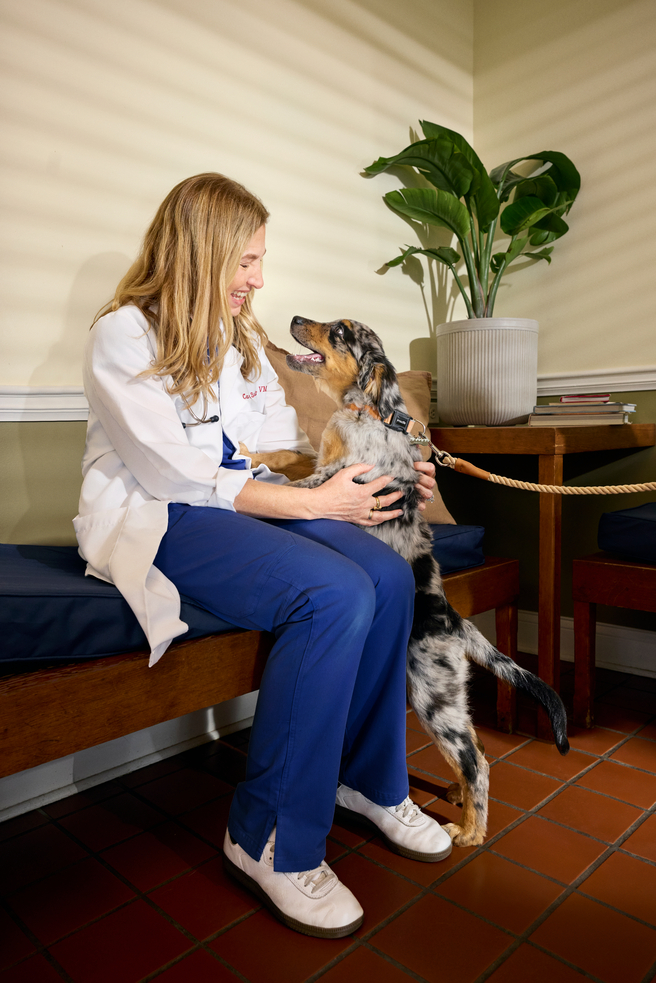
Provide relief for teething.
Teething is related to the process of adult teeth replacing baby teeth. You can expect your dog’s first adult teeth (incisors) to come in around 20 weeks of age, then continue to emerge until about six months of age. This may last longer in toy breeds, said Dr. Jeffrey.
Look out for retained or persistent baby teeth—when a baby tooth is still hanging on once the permanent tooth has begun to erupt. The result is crowding of the teeth, which can lead to various oral health issues—so check with your veterinarian if you’re seeing persistent baby teeth, as they require removal. Retained baby teeth are most common in small-breed dogs.
Teething can be tough on puppies, and not all puppies react the same way to the process.
Offering soft toys for chewing can be helpful for teething puppies. “Some puppies want to chew everything in sight,” said Dr. Jeffrey. “It’s good to have toys they are allowed to chew nearby in several parts of the living area that can be switched with the things they should not chew.”
You can also try stuffing a food-dispensing toy with your dog’s food, or a banana, and freezing it. When your pup chews these frozen treats, it can soothe and numb sore gums.
It’s important at this stage to keep your clothes, shoes, and other belongings away from your puppy. “Under no circumstances should people let the puppy teethe on them or their clothing,” said Dr. Stelow.
Develop good dental hygiene habits now.
According to the American Veterinary Medical Association, more than 80% of pets older than three years of age have active dental disease—but it’s an often-overlooked health issue. Veterinarians say the most effective way pet owners can help prevent dental disease, gingivitis, and periodontitis is daily toothbrushing at home. Having a puppy means you have an opportunity to establish good habits and get your pup used to this daily ritual.
When your puppy is young, before their adult teeth have emerged, get them used to your fingers in their mouth by rubbing their gums. Make sure they’re comfortable at every stage of the process so that they grow to get used to it or even like it. Once they have all their adult teeth, you can try introducing brushing with a toothbrush designed for dogs. You can also start by using your finger wrapped in gauze, or a small rubber brush that fits over your finger. Be sure to use a veterinary-specific toothpaste made for dogs. Check the Veterinary Oral Health Council for recommended toothpastes.
Keep your puppy safe.
Puppies are energetic and curious, making it easy for them to get into just about anything. Supervising your dog and taking safety precautions can go a long way in preventing disasters.
Puppy-proof your home.
Anything dangerous to a puppy or valuable to you should be locked away from the dog’s reach. These include:
- Electrical cords, chargers, headphones
- Medications, household cleaners, alcohol and other hazardous substances
- Toxic plants
- Human food, garbage
- Anything you don’t want destroyed (such as shoes, socks, clothes, and blankets). “These can cause injury to the mouth and lungs and can even get stuck in the intestines, requiring emergency surgery,” said Dr. Waltzek.
If it’s not possible to puppy-proof certain rooms, baby gates can keep the puppy out. “There’s no reason that this should change as the puppy ages, since adult dogs can be interested in socks and garbage, too,” said Dr. Stelow.
Get your puppy microchipped.
Even if you take steps to make sure your puppy can’t escape from your home, veterinarians recommend getting your puppy microchipped and keeping your contact information up-to-date. A microchip is the most effective way of locating a lost pet.
Socializing and training your puppy
Puppy socialization is a crucial aspect of training. Between 4 and 16 weeks old, puppies experience a critical socialization window “when they are especially receptive to new experiences and learning about the world around them,” said Dr. Ng. “During this time, it is beneficial to gradually and positively introduce puppies to a variety of people, environments—such as cars and veterinary clinics—sounds, objects, and other animals, provided those animals are healthy and friendly.”
This sensitivity period is the best time to acclimate your pup to anything and everything they’ll encounter in everyday life, from toothbrushes to booties. “This is the time that the puppy is most open to new things, and we want to make sure that he thinks of all of those things as ‘normal’ as he grows up,” said Dr. Stelow.
Start positively reinforcing good potty habits in the new home right away. Many trainers recommend crate training—but, no matter what route you choose, owner vigilance and frequent potty breaks are a must.
In general, Dr. Stelow said, training should always be fun and positive. It will also extend long beyond the puppy years. “It’s lifelong and owners should always be prepared for backward and forward progression,” said Dr. Baker. Be persistent and proactive about training your puppy, as “behavior is the biggest reason for rehoming.”
Should you hire a dog trainer or behaviorist?
You may also consider hiring a professional trainer or behaviorist, or sign your puppy up for group classes. This environment can help socialize your puppy and acclimate them to other dogs, which will serve them the rest of their lives. “Socialization is very important when puppies are young,” said Dr. Jeffrey. “Unless it’s necessary to have one-on-one training lessons, I prefer group settings because of the socialization aspect. I feel owners learn just as much from the training as puppies.”
To find reliable veterinary behaviorists and trainers, ask your veterinarian (and friends with well-behaved dogs) for recommendations. Or, check with organizations like the American College of Veterinary Behaviorists for board-certified veterinary behaviorists, or The Association of Professional Dog Trainers for certified trainers.
Budgeting for veterinary care
Your puppy will need veterinary care beyond basic check-ups and shots, and it can be expensive. Consider starting a savings account for your puppy, researching pet-insurance options, or finding another way to budget specifically for vet emergencies and care. No matter how you choose to finance your dog’s medical needs, you should go in with a plan.
This is a lot of information to take in, and there is a learning curve involved when you adopt a dog. Taking care of these essential tasks now, however, can help set your puppy up for a lifetime of good health.
More tips for raising a puppy:
- How to Potty Train a Puppy
- What Are the “Puppy Blues,” and How Should You Deal?
- Why The Farmer’s Dog Is Great for Your Puppy
The post Puppy Veterinary Care Guide: a Health Checklist for Your New Best Friend appeared first on The Farmer’s Dog - Digest.
Comments
Post a Comment