In this article:
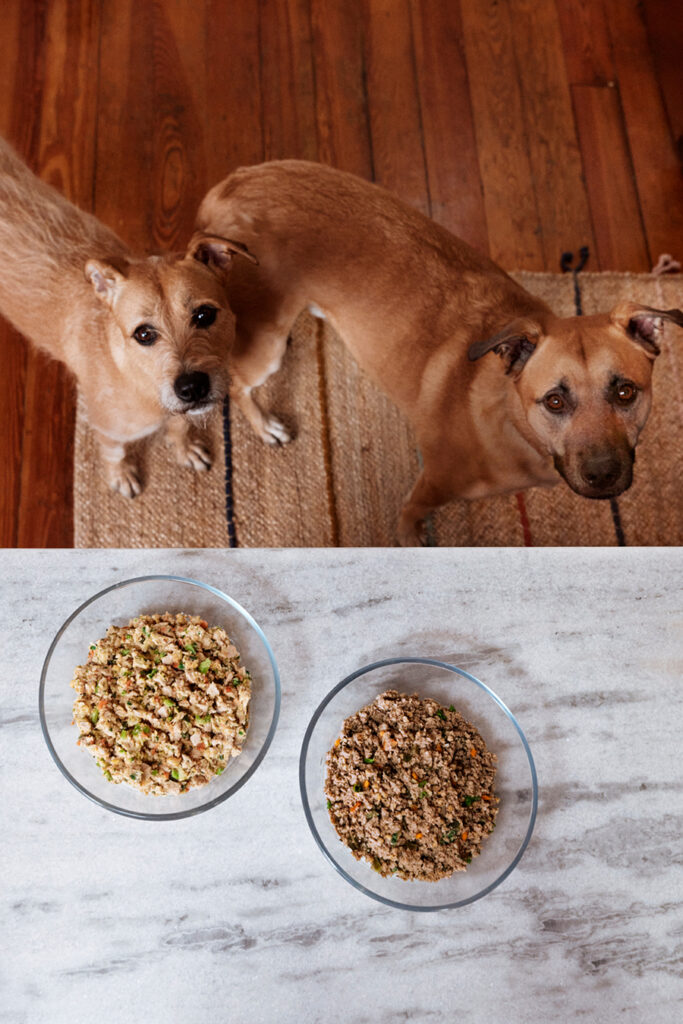
- Should I keep my dogs separated during meals?
- How can I tell if my dogs are stressed during meals?
- When is it okay to let dogs eat together?
- What happens to mealtimes when you introduce new dogs into the household?
There are many reasons to love life in a multi-dog household. If the dogs get along, they’ll always have a friend around and may even reap health benefits. And you—well, you get to live with more dogs.
But if you’ve ever watched two dogs beeline for a dropped breadcrumb, you know that dinnertime in a multi-dog home can test those good vibes. Dogs love food, and may be suspicious of anyone who they think might take it away from them—even an adorable fellow-dog.
To make feeding time smoother in multi-dog households, we called two pros who spend their days helping dogs and their people navigate this stuff: First, behavior consultant and trainer Kate LaSala of Rescued By Training—who specializes in helping dogs overcome fear and aggression issues, and has maintained a multi-dog household for years thanks to a steady stream of fosters. And second, trainer and behavior consultant Alexis Toriello of Zen Dog Training in New York, who has nearly two decades of experience working with city dogs and the humans who love them.
LaSala and Toriello both say the goal isn’t perfectly “polite” shared mealtimes, but management strategies that work for your dogs and your life. In the end, the only excitement at dinnertime should be about what’s in the bowl(s). Here’s how to get there.
Always start with managed separation.
Both trainers recommended feeding dogs apart, especially at first, even if there are no obvious-to-you signs of stress.
Feeding together “could be building resentment between them that you don’t even know is there,” Toriello said. Even if you don’t see it, your dogs may view each other as possible competitors for food. “It may never come to anything, or it might.”
She said that added stressors increase the risk that tension could bubble over into confrontation. “Let’s say you have a baby,” she said, “or you have a group of visitors that stresses [your dogs] out and pushes them over the edge one day. You don’t want to build that baseline of resentment. It’s not worth the risk.”
LaSala pointed out that some degree of resource guarding—that is, when dogs protect food or other valuable things—is a normal behavior and still “built in” even if your dog has never gone hungry.
Separating dogs during meals is a simple way to avoid triggering that instinct.
Here’s how to do it:
- Use physical barriers. Baby gates, exercise pens, crates, closed doors, or even strategically placed furniture that keeps your dogs in opposite corners of a small space can all work.
- Feed at the same time, but in different spots. You don’t need separate mealtimes—just separate zones, so everyone can relax and eat at their own pace.
- Pick up bowls when they’re done. When both dogs finish, bowls go up. No one gets to cruise for leftovers.
The barrier strategy works whether you have a suburban mudroom and two-car garage or a one-room apartment in the middle of downtown. It’s a management plan that fits any floor plan.
Tip: Toriello notes that some dogs need full visual barriers (as in they can’t see each other at all), while others do fine eating at a distance. If you see your dogs frequently staring and checking on each other, err on the side of out of sight.
How to tell if your dog is stressed at meals.
Many dogs won’t make it obvious to their humans that they’re uncomfortable when other dogs are near their food; growling and lunging are not the only signs of resource guarding.
Here’s what to watch for:
- Freezing or hovering. The dog goes still over the bowl, and their body stiffens. Maybe they angle their body to keep the other dog in view.
- Staring at or “side eyeing” the other dog. They’re tracking the competition, not casually looking around. Watch for their eyes going a little wide or sideways, which trainers refer to as “whale eye.”
- Eating unusually fast. You might think, “Wow, they love this food,” and we at The Farmer’s Dog would understand that. But what they may actually be thinking is, “I’d better finish before that guy comes over.”
- Tension in the face and body. Tight mouth, ears pinned back, muscles clenched—that is, not the loose posture of a dog enjoying a relaxed dinner.
- Obvious signals like growling or lip curling. You may recognize these classic signs of fear, aggression, and stress.
LaSala made this point clear: growling is a very normal communication mode—it’s a warning, and never something to scold away. The moment you hear a growl at the food bowl, your human brain may tell you to yell or clap to make it stop. But if you punish a dog for growling, the dog may learn to stop this less intense behavior without changing how they feel about sharing food. That’s how you end up with the dog who seems to “[bite] out of nowhere,” LaSala said. So never punish a dog for growling.
Toriello also said to remember that a tail wag doesn’t automatically mean “happy.” Obviously, if your dogs are excitedly wagging their tails as dinner approaches, that could mean they’re looking forward to eating. But wagging during the meal isn’t always a good thing—tail wags can also indicate anxiety or aggression.
Tip: Don’t get hung up on feeding order. Some people think that feeding the dog who jumps or yips for food second teaches them to wait. Toriello doesn’t recommend overthinking it—feeding a pushy dog second every time can actually confirm for them that they need to advocate loudly for their food. Mix up who goes first.
When (and whether) to loosen management
If there’s already tension or a history of fights, management in the form of separation may be the long-term solution, not a temporary step. LaSala notes that dog–dog resource guarding is harder to modify than dog–human guarding, and many families reasonably decide the training lift isn’t worth it when simple barriers work.
However, you can consider cautiously experimenting with shared mealtimes and spaces if all of these apply to your household:
- There is no history of fights or injuries around food.
- Both dogs have a long, positive history together and good social skills.
- You can read body language well, and you’re working with a trainer who can coach you.
If you decide to test less-managed dinnertimes, go gradually. Continue using leashes, gates, or a trainer-guided setup where the “guarding” dog gets extra-good stuff when the other dog is present. That way, the presence of a dog predicts bonus food instead of competition.
You can go back to separate meals at any point without bothering your dog(s). Remember that you don’t get extra credit for risk.
What if you’re adding a puppy or another new dog to the household?
Bringing home a second (or third) dog can be a challenge initially. Both trainers stressed that it’s asking a lot of your dog to share food, toys, people, and space with a stranger. And, even if your existing dog and the newcomer are literally littermates, they are still strangers.
“Just because they are the same species doesn’t mean they’re automatically going to get along,” Toriello said. “You need to give them time to develop a relationship, develop trust, develop comfort.”
LaSala used this analogy: imagine you’re at dinner with your partner, sharing a nice dessert. You’d probably share it, because you’re comfortable with this person. Now imagine the stranger at the next table leans over and puts their fork in your food. Different story entirely. Your resident dog isn’t being antisocial by not wanting to share their bowl with someone they met a week ago; they’re being reasonable.
Dogs from resource-limited backgrounds, like strays or those who have spent time in shelters, may be especially primed to guard food, even now that they’re in a safe home. But a dog’s background doesn’t always predict how they’ll be around their food—again, guarding resources is instinctual. Any dog might do it.
Having more than one dog is often wonderful, but dinnertime is one part of their lives together that requires a little more thought and infrastructure. Baby gates are easy to come by. The peace of mind—and the sight of two happy, relaxed dogs eating their favorite foods—is worth it every time.
The post How to Handle Mealtimes in a Multi-Dog Household appeared first on The Farmer’s Dog - Digest.
Comments
Post a Comment