In this article:
- What are displacement behaviors?
- What are some examples of dogs’ displacement behaviors?
- Why do dogs engage in displacement behaviors?
- What can dog owners do when they notice displacement behaviors?
- When should I call a trainer or veterinarian to address my dog’s displacement behaviors?
If your dog suddenly starts sniffing the ground during a tense moment at the dog park, they may not be tracking an exciting new smell. If they yawn when meeting new people, they’re not being rude. Instead, they might be displaying what animal behaviorists call “displacement behaviors.” Learning to recognize these subtle signals can help you better support your dog’s emotional well-being and strengthen your relationship with them.
What are displacement behaviors?
Lore Haug, DVM and Board Certified Veterinary Behaviorist at Texas Veterinary Behavior Services, offered this simple definition: Displacement behaviors are “normal behaviors that occur in an abnormal context.” When they experience internal conflict, dogs may display these behaviors, which lack an apparent function related to what’s going on around them.
Unlike a bark that’s meant to scare away a threat, or a move toward something tasty that a dog would like to eat, displacement behaviors may seem “pointless.” But they serve as indirect coping mechanisms.
“[Displacement behaviors] generally arise in situations of conflict or uncertainty. Situations where the animal must choose between two or more undesirable options and they ‘displace’ into a third unrelated behavior,” Haug said.
You can think of displacement behaviors as your dog’s way of self-soothing when they’re feeling overwhelmed. I like to think of it like a guy at a party who doesn’t know anyone and spends the whole time at the appetizer table sampling ham biscuits. It’s normal for people to eat ham biscuits at a party, but in a friendlier context this guy might not spend so much time doing so.
What are some examples of displacement behaviors?
According to Haug, the following may be displacement behaviors if a dog displays them while facing social pressure or uncertainty:
- Scratching
- Licking their lips repeatedly
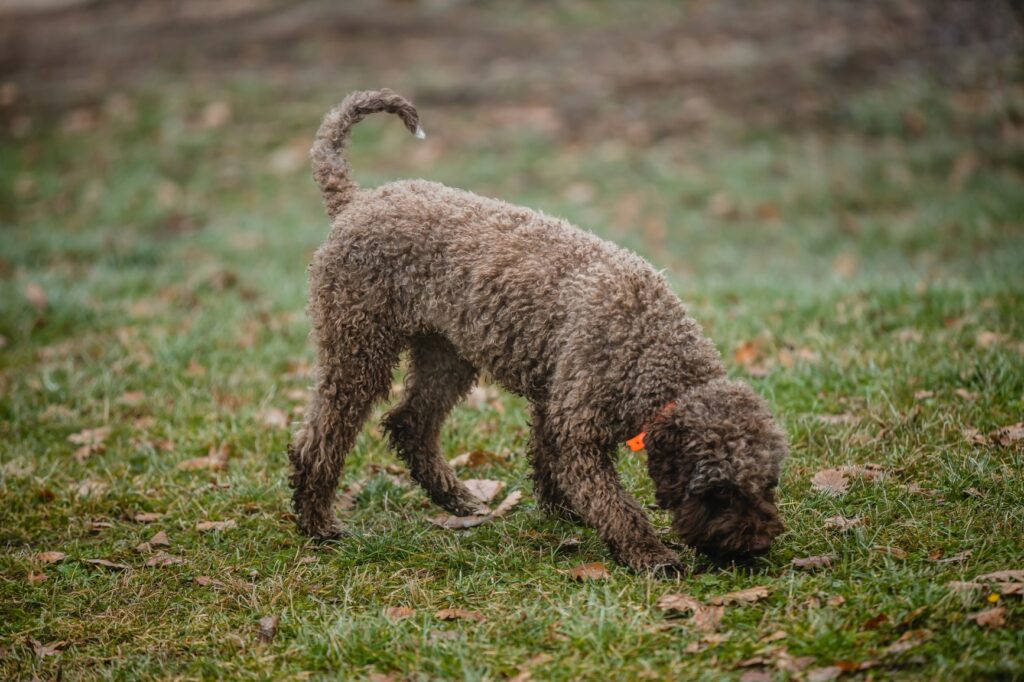
- Sudden ground-sniffing
- Frantic eating
- Spinning or tail chasing
Rarer displacement behaviors include dogs excessively grooming or licking themselves.
Some trainers believe that dogs who pick up toys when a person arrives home may be engaging in displacement behavior. Marc Bekoff, PhD, professor emeritus of Ecology and Evolutionary Biology at the University of Colorado, Boulder, told us for an earlier article about reasons dogs bring things to their owners: “Two of my dogs—Inuk, a malamute, and Jethro, a mutt—used to do that on occasion, especially when someone came to the door or into the house, and they had been sleeping or elsewhere and hadn’t known someone was there. I hadn’t thought of it as a ‘formal’ displacement behavior, but I suppose it could be viewed that way—perhaps they and other dogs were really excited, and [grabbing a toy] was the only outlet for them to do something. It might also be an invitation to play with them.”
Why do dogs engage in displacement behaviors?
It’s generally thought that displacement behaviors are a way for dogs to reduce stress, Dr. Haug said. She likened these canine behaviors to a person’s nervous laugh when they feel awkward or out of place. “Dogs will frequently sniff in the environment even though they are not interested in exploring,” she said. “Again, the sniffing behavior is designed to help reduce stress in the animal.”
A 2023 study published in Animal Cognition explored these behaviors as a possible communicative tool, helping dogs navigate complex social situations without escalating to more serious conflicts, which they called “displacement as appeasement.”
Whatever the reason for displacement behaviors, if they show up in stressful situations they can be signs that your dog feels uncomfortable.
What can dog owners do when they notice displacement behaviors?
Being able to recognize displacement behaviors can help us understand more about how a dog is feeling in any given context, and act accordingly. For example, if a dog yawns when they’re not tired, licks their lips, or scratches themselves in the middle of a social interaction—whether with fellow dogs or with humans—they may feel conflicted. In this case, you can let your dog move away from the thing that is making them uncomfortable, or move the thing away from your dog.
So when you notice what may be displacement behaviors, assess the situation from your dog’s perspective. Are they being approached too quickly? Is the environment overwhelming? Small changes like creating more space, slowing down interactions, or removing your dog from the situation can make a difference. Most of the time, these simple interventions are enough to address your dog’s stress. However, when displacement behaviors are chronic or affect your dog’s quality of life, it’s probably time to call a professional.
When should you call a trainer or veterinarian about your dog’s displacement behaviors?
Sometimes displacement behavior can be a dog’s way to manage their own stress, which is a good thing. As Huag said, “Displacement behaviors are a natural response to stressful situations. Not every instance requires intervention.”
But, she emphasized, if the behaviors “are arising frequently and/or across multiple contexts of the pet’s life, this suggests a significant welfare concern for the animal. Intervention is required if the pet shows intense displacement behaviors in certain situations, or even lower-level but frequent displacement behaviors across multiple contexts.”
Anything that interferes with your dog’s quality of life is something you should address, perhaps with the assistance of a certified trainer or veterinary behaviorist. A dog licking themselves to the point that they get hot spots or hair loss, for example, needs help.
Dogs are always communicating with us, but we often miss their signals. Our dogs can’t talk aloud and say, “I’m uncomfortable, Jerry. Can we move over there?” Familiarizing ourselves with our dogs’ displacement behaviors (and, importantly, the contexts in which they arise) is one of the best ways to support our best friends. And it gets us that much closer to speaking dog.
The post Can You Recognize Your Dog’s Displacement Behaviors? appeared first on The Farmer’s Dog - Digest.
Comments
Post a Comment